

NHS home sleep apnoea tests: who can get one and how referral works: an evidence-based guide to eligibility, referral, costs and follow-up
NHS home sleep apnoea tests explained, including who may be referred, what the equipment records, how local NHS pathways work, when laboratory testing is needed and how private costs typically compare.
Key facts
- A home sleep study commonly records airflow, breathing effort, blood oxygen, pulse and body position during sleep.
- NHS referrals may come from a GP or another qualified healthcare professional, with local services setting their own pathway.
- Published 2026 UK guides place private home testing at approximately £150 to £600, depending on what interpretation includes 1 2.
- Some NHS sleep services prioritise safety-sensitive cases, including people whose daytime sleepiness affects driving or other alertness-critical work 3.
NHS home sleep apnoea tests are usually portable overnight investigations arranged through a sleep service rather than a universal walk-in service. The central questions are whether a qualified professional considers obstructive sleep apnoea plausible, whether home monitoring is suitable, and which local NHS pathway accepts the referral. Arrangements differ across England, Scotland, Wales and Northern Ireland, and also between provider areas.
What a home sleep apnoea test measures
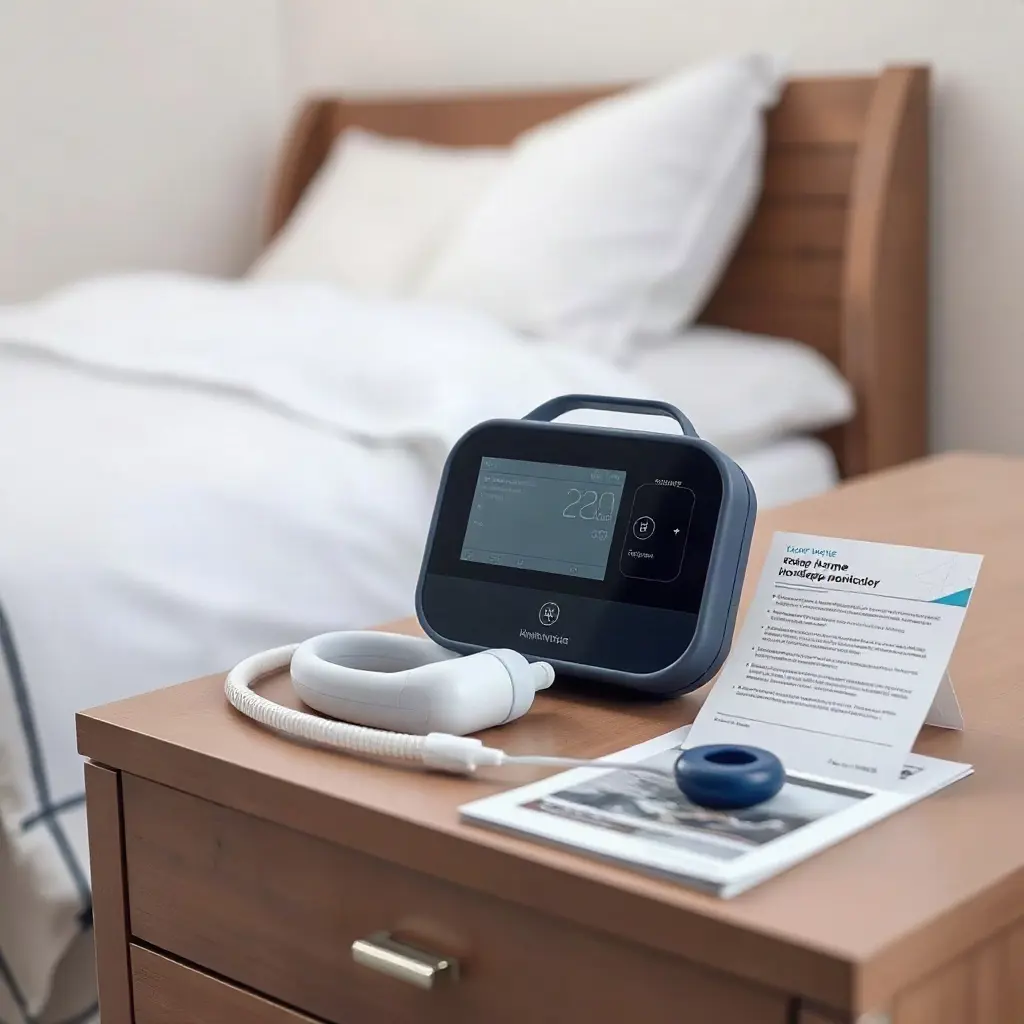
A home respiratory polygraphy test is performed outside a sleep laboratory using a portable monitor. Equipment commonly records airflow through the nose or mouth, breathing effort, blood oxygen, pulse or heart rate, snoring and body position. These signals help a sleep team assess repeated reductions or interruptions in breathing during sleep. A simpler overnight oximetry test may record oxygen levels and pulse, but it provides less information than respiratory polygraphy.
The equipment may be collected from a hospital, fitted during an appointment or delivered with instructions, depending on local practice. Sensors are worn overnight and then returned for downloading and clinical interpretation. Home testing is less complex than attended polysomnography and can be more practical, but it does not record every signal. A full laboratory study may additionally monitor brain activity, eye movements and muscle activity, which can matter when another sleep disorder is suspected.
Who may be considered for home testing
Referral decisions normally follow a clinical history and assessment rather than a single symptom or questionnaire score. Relevant features can include loud snoring, witnessed breathing pauses, gasping or choking during sleep, noisy breathing and marked daytime sleepiness. NHS inform describes these as recognised signs associated with obstructive sleep apnoea 4. Medical history, examination findings, occupation, driving responsibilities and other conditions can also influence the investigation selected.
A qualified professional decides whether a home test is appropriate and whether the local service accepts the referral. A sleepiness questionnaire alone should not determine referral, according to the 2026 summary of NHS guidance, because not everyone with sleep apnoea experiences pronounced sleepiness 3. A referral can therefore remain clinically relevant even when one symptom is absent. Local criteria may be narrower for specialist services dealing with complex cases or particular treatments.
How the NHS referral pathway usually works
The process commonly begins with a GP appointment, although a hospital clinician or another NHS healthcare professional may also start the pathway where local rules permit. The initial assessment usually records sleep symptoms, relevant medical history, medicines, occupation and safety concerns. The referral is then triaged by a sleep or respiratory service. Guy’s and St Thomas’ NHS Foundation Trust states that GP referrals use the NHS e-Referral Service, while non-GP referrals require a consultant route 5.
After triage, the service may arrange an appointment, issue a portable monitor or direct the patient to equipment collection. Instructions should explain sensor placement, recording procedures and return arrangements. The sleep team downloads and reviews the recording before communicating the result and recommended next step. Aintree University Hospital’s regional service, for example, receives GP referrals and provides diagnostic and management services for sleep-related breathing disorders in Merseyside and parts of Lancashire 6.
Where NHS testing is arranged and how waits vary
NHS home testing is generally organised by local sleep, respiratory or ventilation services rather than by a single national testing centre. Named examples include the Sleep Service at Aintree University Hospital in Liverpool and the sleep disorders centre linked with Guy’s Hospital in London. These are examples of specialist provision, not evidence that every area follows the same route. Local NHS websites, GP practices and referral teams can clarify which provider serves a particular area.
Waiting times can differ substantially according to referral volume, staffing, triage priority and whether the required test is home monitoring or attended polysomnography. A 2026 report on England described waits ranging from about one week to 13 weeks or more across hospitals for people already on relevant lists, with a national median of about four weeks at the point measured 3. These figures describe service-level waiting, not a guaranteed individual timeframe. Safety-sensitive cases may receive greater priority.
NHS funding and private cost comparisons
When an investigation is arranged as part of NHS care, eligible diagnostic assessment is normally funded through the NHS and does not involve a direct test charge at the point of NHS treatment. Eligibility, referral acceptance and local availability still apply. Private testing is a separate route, and the price depends on the number of recording nights, sensor type, clinician interpretation, consultation arrangements and whether follow-up is included.
| Investigation | Published 2026 private guide range | Typical scope |
|---|---|---|
| Home sleep study | About £150 to £600 | Portable overnight breathing and oxygen monitoring, with interpretation varying by provider |
| In-laboratory polysomnography | About £600 to £2,000 | Attended study with additional neurological and sleep-related measurements |
Published UK guides give a combined private home-testing range of approximately £150 to £600, while in-laboratory studies are described at roughly £600 to £2,000 in 2026; estimates vary according to inclusions and provider model 1 7 2. A quoted test price may not include specialist consultation, repeat testing, treatment equipment or follow-up, so those elements should be distinguished when comparing routes.
When home testing may not be suitable
A technically incomplete recording may require a repeat test, while an inconclusive or negative home result may lead to attended polysomnography if clinical concern remains. Home monitoring can be less suitable when another sleep disorder is suspected, when the case is medically complex, or when detailed neurological measurements are needed. The decision belongs to a qualified sleep or medical professional, not to the equipment alone.
After interpretation, possible management options depend on the assessment and may include advice about contributing factors, positive airway pressure, an oral appliance or other specialist care. Aintree’s service lists diagnosis and continuous positive airway pressure treatment among its functions, while specialist centres may assess more complex interventions 6 5. Results should be explained by a qualified professional, including limitations, safety implications and whether further testing or follow-up is appropriate.
Sources
- Home Sleep Apnoea Test UK 2026: Cost & How It Works: https://goingprivateuk.co.uk/private-sleep-apnoea-home-test-uk/
- Private sleep study: cost and how it works | Speedwell: https://www.speedwellhealth.co.uk/guide-private-sleep-study-cost
- NHS sleep study waiting times in England | Go Private: https://goprivate.co.uk/waiting-times/sleep-study
- Obstructive sleep apnoea (OSA): https://www.nhsinform.scot/illnesses-and-conditions/lungs-and-airways/obstructive-sleep-apnoea/
- Sleep disorder centre - referrals: https://www.guysandstthomas.nhs.uk/referral-guide/sleep-disorder-centre
- Sleep Service :: NHS University Hospitals of Liverpool Group: https://www.uhliverpool.nhs.uk/services/service-finder/sleep-service
- Private Sleep Study UK: Costs, Home vs Lab & Results: https://goingprivateuk.co.uk/private-sleep-study-uk/