Implant treatment for complex cases - with anaesthesia, no visible sutures: Clinical evidence and patient considerations
Implant treatment for complex cases with anaesthesia and no visible sutures generally combines carefully selected sedation or general anaesthesia with minimally invasive, guided surgery. The phrase “no visible sutures” usually refers to flapless access, internal closure, or dissolvable sutures beneath the gum line, rather than an assurance that every patient will require no suturing at all. 1
What makes an implant case complex
Complexity may result from severe bone loss, advanced periodontitis, non-restorable teeth, sinus expansion, failed implants, or medical and anxiety-related considerations. A reported maxillary rehabilitation case involved advanced periodontitis, multiple non-restorable teeth, localized pain, difficulty chewing, and posterior bone deficiency caused by enlarged sinuses. The diagnostic process included CBCT imaging, clinical examination, photographs, and digital scanning before treatment planning. 2
Severely atrophic upper jaws may require alternatives to conventional implants. Zygomatic implants use dense bone in the cheekbone, while pterygoid implants engage bone in the pterygoid region. These approaches can reduce dependence on extensive grafting in selected patients, although their anatomical pathways make detailed imaging, surgical experience, and prosthetic planning essential. A recent retrospective case-series report specifically examined zygomatic implant placement under local anaesthesia. 3
How anaesthesia may be selected
Local anaesthesia remains the foundation for many implant procedures, including some complex cases. A published case series described zygomatic implant surgery under local anaesthesia, with or without conscious sedation, as an approach made more practical by virtual planning, guided surgery, and improved instrumentation. Reported reasons for considering local anaesthesia include avoiding general-anaesthesia exposure, simplifying logistics, and supporting outpatient care when clinically appropriate. 3
Intravenous sedation and general anaesthesia are separate levels of care and require appropriate patient assessment, monitoring, facilities, and trained practitioners. In Australia, dental sedation and anaesthesia operate within oversight from the Dental Board of Australia, while standards from the Australian and New Zealand College of Anaesthetists address safe medical practice. Complex procedures requiring general anaesthesia are commonly associated with day-surgery centres or hospitals and oral and maxillofacial surgical teams. 4
Planning before surgery
Computer-guided implant treatment begins with three-dimensional imaging and prosthetic planning rather than the surgical incision. In a documented full-arch case, a radiographic stent with reference markers was used, followed by two CBCT scans, one with the patient wearing the stent and one of the stent alone. This double-scan method transferred planned restorative information into the surgical design and supported guided placement. 5
Guided surgery can help the clinician account for reduced bone volume, sinus position, implant angulation, and the intended prosthesis. A full-arch rehabilitation report described guided flapless surgery after extraction and a healing period with a provisional removable prosthesis. Another clinical case used a surgical guide with internal cooling in an All-on-4 “M” configuration. These reports are individual cases, not proof that the same method suits every patient. 6
What “no visible sutures” actually means
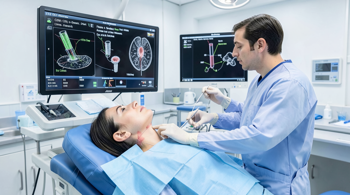
Flapless surgery limits the need to reflect a broad gum flap, which can reduce tissue manipulation and may result in fewer external stitches. A case report involving a 78-year-old patient with chronic periodontitis used CBCT-based planning and flapless implant placement through a pinhole surgical technique. The report described uneventful healing, minimal discomfort, stable osseointegration, and healthy peri-implant tissues at six months and one year. 7
When closure is needed, sutures may be placed internally or beneath the gum line, and some oral-surgery sutures are resorbable rather than requiring a separate removal appointment. However, flapless access is not synonymous with suture-free surgery. Bone grafting, sinus lifting, extraction of multiple teeth, unexpected anatomy, or the need for wider access can change the surgical plan and make visible closure necessary. 8
Immediate provisional teeth and healing
Immediate loading depends on achieving adequate primary stability and maintaining a controlled restorative plan. A case report described removal of six maxillary cysts, extraction, bilateral sinus lifting, bone grafting, and placement of 12 implants in one session, followed by fixed temporary teeth on the same day and a six-month healing phase before the definitive prosthesis. The authors presented this as an unusual, carefully planned case rather than a routine protocol. 9
Severely resorbed maxillae may sometimes be rehabilitated with zygomatic anchorage. One clinical account stated that zygomatic cortical bone delivered insertion stability measurements of ISQ 65 to 75 and described same-day provisional bridges in selected severely deficient jaws. Such figures are case-specific and should not be treated as a universal threshold or guarantee. Smoking history, diabetes, bone quality, infection, and previous implant failure can narrow the margin for predictable immediate loading. 10
Eligibility, risks, and ongoing maintenance
Eligibility cannot be determined from the desire for anaesthesia or invisible sutures alone. Assessment normally considers medical history, anxiety, periodontal condition, infection, bone volume, sinus anatomy, restorative objectives, and the ability to follow postoperative instructions. Controlled diabetes, smoking history, poor bone quality, active infection, and previous implant failure were identified in the supplied clinical material as factors that can increase treatment complexity or compromise immediate-loading decisions. 10
Minimally invasive surgery may reduce tissue trauma, but it does not remove the risks associated with implant treatment, grafting, sinus procedures, anaesthesia, infection, or prosthetic complications. Postoperative care for minimally invasive or suture-reduced cases emphasizes careful oral hygiene and antimicrobial rinses, while long-term success depends on professional reviews and maintenance of peri-implant tissues. Individual outcomes vary, and clinical evidence drawn from case reports cannot replace a patient-specific examination. 1
Sources
- Dental Board of Australia, Guidelines and codes
- PIC Dental, Rehabilitation of maxillary FP1 with advanced periodontitis and bone deficiency
- Zygomatic Implants Under Local Anaesthesia, retrospective case series
- Australian and New Zealand College of Anaesthetists, standards for medical practice
- DDS News, Full-arch implant rehabilitation using guided flapless surgery
- Journal of Clinical Medicine, Full-Arch Oral Rehabilitation in All-on-4 “M” Configuration
- International Journal for Multidisciplinary Research, Flapless Implant Placement Using the Pinhole Surgical Technique
- Healthline, Use of dissolvable sutures in oral surgery
- International Plus, Immediate Loading Dental Implants Despite Six Cysts
- Dazzle Dental, Single-Day Implants for Complex Cases