Gardening on a budget: thrifty tips for using affordable plants and supplies in Australia
Gardening on a budget in Australia is not a compromise, it is a strategy. According to veteran market gardener Louise Sales of Tasmanian community hub The Material Institute, most families could save approximately $50 a week on groceries by growing some of their own fruit and vegetables. 1 With the average Australian family spending around $240 per week on groceries, and fresh produce representing a significant share of that figure, even a modest edible garden can deliver measurable financial relief year-round. 2
Seeds Over Seedlings: The Single Most Effective Cost Reduction
The fastest way to slash plant costs is to switch from purchasing nursery seedlings to growing from seed. A single packet of lettuce seeds costing approximately $4 can yield more than 200 plants, compared to buying seedlings at roughly $3 each individually. 2 That arithmetic alone makes seed propagation one of the most powerful tools in the Australian budget gardener's toolkit. Varieties particularly well suited to seed starting in Australian conditions include lettuce, rocket, basil, beans, parsley, zinnias, and marigolds, all of which germinate reliably and mature quickly. 3
For native plants, tube stock represents the most economical nursery option. Tube stock refers to small native plants grown in tall, narrow containers, sold at a fraction of the price of a potted specimen in a 140mm or larger container. 4 Research consistently shows that small plants experience less transplant shock, develop root systems that spread naturally into surrounding soil from the outset, and adapt to site-specific conditions more effectively than advanced stock. A tube stock planted in the right season will frequently catch up to, or overtake, a more expensive advanced plant placed in the ground at the same time. 4 For self-seeding natives, everlasting daisies, brachyscome, native grasses, and billy buttons can colonise bare ground around established plantings at essentially zero ongoing cost if spent flower heads are left to set seed rather than deadheaded prematurely. 4
Propagation from Cuttings and Plant Swaps
Many popular garden plants, including succulents, rosemary, lavender, and geraniums, propagate readily from cuttings taken from established specimens. 5 Once this skill is acquired, paying full nursery price for these species becomes largely unnecessary. Using moisture-retentive propagation media and self-watering setups during the striking phase can reduce water waste by up to 40%, making the process both resource-efficient and compliant with local water restriction guidelines. 6
Plant swap networks have grown substantially across Australia, with local council events, Facebook gardening groups, and community nurseries all operating as conduits for free or near-free plant material. 7 Trading excess seedlings, cuttings, or divided perennials with other gardeners is a reliable method for expanding a garden's diversity without any financial outlay. Gardening Australia's long-running series has dedicated entire episodes to thrifty gardening ideas built around exactly this kind of community exchange. 8
Native Plants: Lower Input Costs Over Time
Australian native plants, including kangaroo paw, grevillea, and bottlebrush, are adapted to local climate conditions and require significantly less water and fertiliser input than most exotic ornamentals once established. 9 Research from Aussie Animals documents that native plants can require up to 80% less water than exotic species, a figure that translates directly into lower water bills, particularly relevant given tightening council water restrictions across New South Wales, Victoria, South Australia, and Western Australia. 9 Western Australia's seasonal sprinkler switch-off between 1 June and 31 August further underlines the practical importance of selecting drought-tolerant species from the outset. 5
Native plants also support local pollinator populations, including native bees, butterflies, and nectar-feeding birds, which in turn improve the productivity of any food garden grown nearby. 10 TV presenter and garden designer Mark Lane, author of the 2026 reference title The Thrifty Gardener: Reduce Waste, Spend Wisely, emphasises choosing plants that are well-suited to local environmental conditions as a foundational principle of cost-conscious garden design. 11 Lane notes that five packets of seeds can cost less than the equivalent of a single advanced nursery plant while filling a garden bed with productive, pollinator-attracting native species. 11
Free and Low-Cost Soil Inputs: Compost and Mulch
Home composting is one of the most consistently effective ways to eliminate recurring expenditure on commercial fertilisers and soil conditioners. Kitchen scraps, grass clippings, and fallen leaves can all be converted into nutrient-rich compost, with sustained composting estimated to save a household $50 to $100 annually in purchased soil amendments. 7 Collecting used coffee grounds from local cafes provides an additional free source of organic soil conditioner, though grounds should be mixed with other organic matter rather than applied in concentrated quantities due to their acidity. 12
Mulching garden beds is equally important for reducing water consumption and suppressing weed growth, both of which represent ongoing cost centres for unmanaged gardens. Sugarcane straw mulch costs approximately $15 to $20 per bag and is widely regarded as the most practical budget mulch for vegetable gardens. 12 Wood chips are frequently available at no cost from local tree removal companies and perform well in ornamental garden beds, though they are less suitable for vegetable patches. Cardboard and shredded paper suppress weeds effectively and can be sourced freely from packaging waste, while DIY leaf mould costs nothing and is ready for use after approximately one year of decomposition. 12 One important caveat: low-cost mulch sourced without care can introduce weed seeds, so the origin of any bulk material should always be verified. 12
Recycled Containers, Beds, and Structures
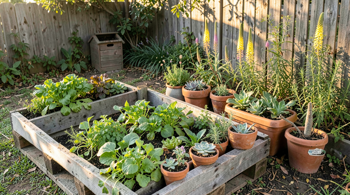
Commercial raised bed kits range from approximately $200 to $800 in Australian retail contexts, placing them out of reach for many gardeners. 13 Wooden pallets, leftover concrete blocks, bricks, and dismantled besser blocks sourced from demolition sites, furniture stores, and garden centres provide structurally sound raised bed walls at little or no cost. When using pallets, only heat-treated (HT) stamped timber should be used, as chemically treated pallets can leach harmful compounds into soil. A single standard pallet stood upright creates an instant raised bed of approximately 1.2m x 1m x 15cm in depth. 13
For containers, repurposed household items including yogurt cups, egg cartons, old buckets, tin cans, and plastic milk cartons serve as functional seed starters and small plant pots when drainage holes are added to the base. 14 Budget garden transformations analysed by SavingsRoom document complete backyard makeovers delivered for under $50 per project element, including vertical herb gardens built for approximately $28 using warehouse finds, recycled tyre planters for around $15, and homemade compost bins for roughly $35. 15 The hugelkultur method, which involves building a base layer of logs and branches, covering them with smaller organic matter, and topping with soil, allows raised beds to be filled with minimal purchased soil while simultaneously improving water retention and nutrient availability over time as the buried wood decomposes. 16
Water Management and Companion Planting Strategies
Water costs represent a significant and often underestimated ongoing expense in Australian gardens, particularly during summer months. Watering early in the morning or late in the evening minimises evaporative loss to midday heat, while drip irrigation systems and soaker hoses reduce water consumption by up to 50% compared to conventional sprinkler systems. 7 Mapping a garden's microclimate, including identifying areas that receive at least six hours of morning sun with afternoon shade during peak summer, reduces heat stress on plants and significantly lowers the frequency of irrigation required. 17
Companion planting offers additional cost efficiencies by improving yields without expanding garden footprint. The pairing of tomatoes with basil is a well-documented example for Australian conditions: basil repels aphids and whiteflies, reducing the need for commercial pest treatments, while tomatoes provide natural shade for the basil during high-temperature periods. 18 Succession planting, sowing small quantities of fast-growing crops like lettuce, pak choy, and kale at staggered intervals, ensures continuous harvests and reduces the food waste associated with gluts that outpace household consumption. Louise Sales of The Material Institute specifically recommends herbs and salad greens as starting points for beginner food gardeners, noting that they are both relatively expensive to purchase at retail and straightforward to grow with minimal ongoing effort. 1
Realistic Considerations and Common Pitfalls
Budget gardening in Australia carries genuine challenges that are worth understanding before committing resources. Propagation requires patience, consistent moisture management, and some tolerance for early failures, particularly for gardeners new to seed starting or cutting propagation. Climate zone differences across Australia mean that timing and technique must be adapted to local conditions: cuttings in Mediterranean Western Australia may require more frequent misting, while tropical Queensland environments demand increased airflow to prevent fungal disease during propagation. 6
Tool quality represents another documented risk area. Research from SavingsRoom warns that investing in very low-cost garden tools frequently results in replacement costs of $200 or more over time, making mid-range, durable tool purchases a more economical long-term choice despite the higher initial outlay. 15 Additionally, gardeners should check local biosecurity guidelines before obtaining cuttings or plant material from outside their region, as some Australian states and territories impose restrictions on the movement of certain plant species to prevent the spread of pests and invasive weeds. 6 Raised garden bed construction using polycarbonate panels for any attached greenhouse structure costs roughly $15 to $30 per square metre, compared to $40 to $80 per square metre for glass, making polycarbonate the clear cost-effective choice for budget builds in Australian conditions. 19
Sources
- ABC News Australia – Families could save up to $50 a week growing their own fruit and vegetables (abc.net.au)
- SavingsRoom – 100 Frugal Gardening Tips for Aussie Garden Savings (savingsroom.com)
- The Curious Gardener – Gardening On A Budget: 20 Ways To Save Money In The Garden (thecuriousgardener.com.au)
- Minimalist Gardener – Tips for Starting an Australian Native Garden on a Budget (minimalistgardener.com.au)
- Little Aussie Communities – How to cut costs in the garden (littleaussie.com.au)
- OWLNO – How to Propagate Plants from Cuttings in Australia: Your 2026 Budget-Smart Guide (owlno.com)
- Frugal and Thriving – The Complete Guide to Successful Gardening For Free (frugalandthriving.com.au)
- TV Calendar – Gardening Australia S36 E26: Grow it Yourself: Thrifty Gardening Ideas (tv-calendar.com)
- Aussie Animals – Budget Australian Bush Paradise: 20 Cheap Landscaping Ideas (aussieanimals.com)
- Local Ipswich News – Spring Container Gardens for Native Pollinators (localipswichnews.com.au)
- Makhazdi Omerovic / The Independent – The Thrifty Gardener by Mark Lane: Reduce Waste, Spend Wisely (makhadziomerovic.com)
- Better Homes and Gardens Australia – Cheap Mulch: How To Mulch Your Garden Cheaply (bhg.com.au)
- Gardening Hub – Free and $50 Raised Garden Bed Ideas Using Recycled Materials Australia (gardeninghub.com.au)
- Wyee Nursery – 4 Dollar Store Gardening Tips for a Thriving and Thrifty Spring Garden (wyeenursery.com.au)
- SavingsRoom – 7 Budget Garden Ideas Under $50 (savingsroom.com)
- Better Homes and Gardens Australia – How to fill a raised garden bed cheaply: hugelkultur and more (bhg.com.au)
- OWLNO – How to Design a Low-Water Garden for Australian Drought in 2026 (owlno.com)
- SavingsRoom – Three Veggie Growing Hacks Save $300 Monthly (savingsroom.com)
- Gardening Hub – Cheap Greenhouse Ideas Under $500: Budget DIY Options for Aussie Gardeners (gardeninghub.com.au)