7-day stay in Sydney with accommodation and meals: A practical cost and planning report
A 7-day stay in Sydney with accommodation and meals can be organised as either an independent city visit or a guided arrival package. Published itineraries show that a week may include the Opera House, The Rocks, Bondi, Manly, the Blue Mountains, inner-city neighbourhoods and shared meals, while accommodation ranges from hostel dormitories to mid-range hotels. 1
What a seven-day Sydney stay can include
A full week allows more than a short landmark-focused visit. One published plan assigns days to harbour icons, Bondi and Coogee, the Blue Mountains, Manly, the Hunter Valley, inner-city districts and a final harbour day involving Taronga Zoo and Watsons Bay. 2 Another itinerary divides the experience between four Sydney days and two Blue Mountains days, creating a combined city-and-nature schedule rather than keeping every night in central Sydney. 7
Guided programmes provide a different structure. The JENZA itinerary describes airport pickup, hostel accommodation, employment workshops, banking and tax assistance, walking tours, an Aboriginal cultural experience, beach activities and side trips. 1 A separate six-day introduction combines Sydney sightseeing with a South Coast dolphin cruise, a surf lesson, Aboriginal cultural learning and shared meals. 8 These inclusions are programme-specific and should not be assumed in an independent booking.
Accommodation patterns and location choices
Hostel dormitories in Sydney generally begin around AUD 50 to AUD 80 per night, while mid-range hotels are commonly reported at approximately AUD 200 to AUD 350 per night. 11 A five-day Sydney cost guide places mid-range accommodation at AUD 180 to AUD 250 per night, although actual amounts vary with dates, room type and neighbourhood. 9 Seven nights therefore require a meaningful share of the total budget, particularly when private rooms are selected.
Central accommodation is often associated with the CBD or The Rocks, while Darlinghurst, Surry Hills and Paddington are identified as alternatives offering access to city areas and neighbourhood life. 7 A central base reduces some sightseeing transfers, but it may carry higher lodging costs. A stay split between Sydney and the Blue Mountains can provide a different setting, yet it introduces check-in, luggage and transport coordination. Accommodation terms should be checked for deposits, cancellation conditions, shared facilities, linen and meal provisions.
Meal planning and daily food expenditure
Reported daily meal spending varies by travel style. A lower-spending traveller may allocate AUD 50 to AUD 70 per day, while mid-range restaurant dining may require AUD 100 to AUD 150 per day. 12 Over seven days, those ranges represent roughly AUD 350 to AUD 490 or AUD 700 to AUD 1,050 respectively, before considering special dining, drinks or food included in a tour.
Meal arrangements differ substantially between accommodation types and itineraries. The JENZA programme includes a family welcome dinner, while the family itinerary from Zicasso lists dinner with its first-day transfer, accommodation and excursion inclusions. 1 6 Independent travellers can combine restaurants with supermarket groceries from Coles or Woolworths, which are identified as options for groceries and quick meals. 13 Dining plans should account for breakfast, packed food on day trips, dietary requirements and the possibility that organised meals cover only selected occasions.
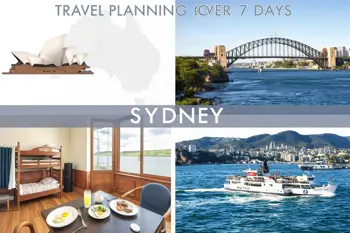
Illustrative seven-day schedule
| Day | Primary focus | Accommodation and meal implication |
|---|---|---|
| 1 | Arrival, Royal Botanic Garden and The Rocks | Airport transfer and first-night check-in |
| 2 | Bondi to Coogee coastal walk | Food near the eastern beaches |
| 3 | Blue Mountains excursion | Allow for an early meal and day-trip provisions |
| 4 | Manly and harbour ferry travel | Return to the Sydney base |
| 5 | Hunter Valley or cultural activities | Possible tour-related meal costs |
| 6 | Surry Hills, Newtown and Sydney Fish Market | Greater choice of neighbourhood dining |
| 7 | Taronga Zoo, Watsons Bay and departure planning | Final meal and checkout timing |
This schedule reflects the sequence proposed in a detailed seven-day Sydney plan, which places harbour landmarks first, beaches and day trips in the middle, and inner-city food districts toward the end. 2 The order can be changed according to weather, opening times and tour availability. A coastal walk, surf lesson, ferry day or mountain excursion may be physically demanding, so meal timing and accommodation access matter when planning each evening.
Transport, admissions and organised options
Sydney’s Opal system covers trains, buses, ferries and light rail, and contactless payment can also be used on applicable services. 14 One itinerary states that the Airport Link reaches Central Station in about 13 minutes and gives an AUD 19.60 Opal fare estimate. 9 Transport costs should be separated from accommodation and meals because a central hotel does not eliminate fares for Bondi, Manly, the Blue Mountains or other outlying areas.
Some activities have separate admission charges. A Sydney Opera House tour is listed at AUD 45 for one hour in a published itinerary, while coastal walks such as Bondi to Coogee are described as having no admission charge. 2 Guided seven-day tours may cost around AUD 812 in one advertised example and can include harbour activities, Bondi, Manly, the Blue Mountains and group leadership, but group sizes may reach 30 travellers. 4 The value depends on which transfers, meals, accommodation nights and admissions are actually specified.
Budget range, seasonality and practical risks
A mid-range seven-day Sydney trip for one person is generally estimated at AUD 1,800 to AUD 2,800 excluding international flights. 15 This range should be treated as a planning framework rather than a quotation because lodging, restaurants, admissions, local transport and day trips can shift the total. A five-day estimate places a mid-range visit at approximately AUD 1,600 to AUD 2,200 in one section and around AUD 1,800 to AUD 2,550 in another, demonstrating how methodology affects published totals. 9
December through February is identified as Sydney’s peak tourist period, when accommodation demand and prices may be higher. 16 March to May and September to October are presented as periods with milder conditions and more manageable crowds in one itinerary source. 9 Practical friction points include weather disruptions, shared-room limitations, cancellation rules, long day-trip transfers and meals that are advertised as included but apply only on selected days. Tipping is not mandatory in Australia, although about 10 percent may be left for exceptional service in high-end restaurants. 17
Sources
- JENZA, “The 7-day One Sydney Itinerary”
- Sydney Tourism, “7 Days in Sydney 2026”
- Booking.com, “Your ultimate seven-day Sydney itinerary”
- HappyToVisit, “7 Day ULTIMATE Sydney”
- Welcome to Travel, “Welcome to Sydney”
- Zicasso, “Seven-Day Sydney Vacation”
- The Adventure Beckons, “7-Day Sydney and Blue Mountains Itinerary”
- GoEco, “Welcome to Sydney Tour and Culture Week”
- Sydney Spirit, “Sydney 5-day essentials”
- Mosqueras, “Best 7 Day Sydney Itinerary”
- Booking.com, Sydney accommodation information
- Budget Your Trip, Sydney daily costs
- Coles, grocery information
- Transport for NSW, Opal and ticketing information
- Lonely Planet, Australia travel costs
- TripAdvisor, Sydney travel planning information
- Australia.com, tipping guidance