Creative ideas for gardening projects on a budget: A Practical Field Guide to Materials, Space, and Maintenance
Creative ideas for gardening projects on a budget often begin with ordinary objects rather than purpose-built garden products. Reused cans, jars, crates, pallets, ladders, colanders, tires, and drawers can become planters or garden features, while composting, seed saving, and waterwise planting can reduce ongoing resource demands. The most suitable project depends on available space, local climate, drainage requirements, structural safety, and the time available for maintenance.
Plan the space before choosing a project
A written layout can prevent unsuitable purchases and overcrowding. A garden plan can divide the available area into growing, sitting, decorative, and storage zones, with measurements recorded before materials are collected. This approach is particularly relevant to balconies, patios, and narrow side yards, where vertical planting may provide more growing capacity without occupying much floor space. A mixed edible garden can combine herbs, vegetables, and flowers, but plant selection still needs to reflect sunlight, container depth, water access, and local growing conditions. 1
| Project condition | Relevant design question |
|---|---|
| Small balcony | Can the structure safely support containers, soil, and water? |
| Patio or concrete area | Can containers be rearranged without blocking drainage or access? |
| Backyard | Would a raised bed, compost area, or planted border fit the layout? |
| Rental property | Can the project be removed without digging or permanent attachment? |
Upcycled containers with practical growing value
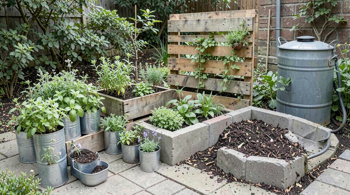
Household containers can provide distinctive planting spaces when they are cleaned, stable, and properly drained. Tin cans can be sanded around sharp edges, painted with leftover exterior-compatible paint, and fitted with drainage holes before holding herbs such as basil, mint, or thyme. Teacups, mugs, wooden crates, vintage drawers, colanders, and food-safe tubs can also serve as small planters. Their main limitation is volume: shallow or narrow containers dry out more rapidly and may restrict root development compared with deeper beds. 2
- Tin cans suit compact herb displays, especially when attached securely to a fence or arranged in staggered rows.
- Crates and drawers can create larger planter boxes, but they require a liner that allows excess water to escape.
- Colanders already contain openings and can function as hanging baskets when the suspension system is strong enough.
- Used buckets and tubs should be food-safe when intended for edible crops, with drainage holes added before planting.
Raised beds and vertical structures
Raised beds do not require a commercial kit. Documented designs include galvanized tubs, cinder-block beds, straw-bale beds, fabric grow bags, five-gallon bucket clusters, lined pallets, and simple timber frames. Reported project estimates range from approximately $10 to $48 for several container and block designs, while a basic two-by-four-foot cedar bed was described at about $38 in one account. These figures are examples from individual guides, not universal prices, because soil, transport, hardware, and local material availability vary. 3
A pallet can also function as a vertical growing wall. One source describes a standard 40-by-48-inch heat-treated pallet as holding roughly 12 to 15 planting pockets, with soil, fabric, and herb seedlings bringing the cited total to around $35. Pallet selection is a safety issue rather than merely an aesthetic choice. Heat-treated wood marked HT is preferred for food-growing applications, while MB markings, unknown chemical treatment, painted boards, and splintered surfaces should be avoided. 4
Soil improvement through household organics
Composting converts kitchen scraps and garden materials into a soil conditioner, while worm farms produce worm castings and liquid fertiliser from suitable fruit and vegetable scraps. A basic compost system can combine food waste, garden clippings, dry leaves, and shredded paper. These methods can reduce the quantity of organic material sent to waste services, but they require attention to moisture, airflow, acceptable feedstocks, and placement. A neglected system may become odorous or attract pests, so the project has an ongoing management requirement rather than being a set-and-forget installation. 5
- Compost systems need a balance of moist organic material and dry carbon-rich material such as leaves or shredded paper.
- Worm farms need protection from excessive heat, drying, flooding, and unsuitable food scraps.
- Finished compost or worm castings should be treated as soil amendments, not automatic substitutes for every growing medium.
- Local waste guidance can determine which materials are appropriate for home processing.
Waterwise projects and resilient planting
Wicking beds store water in a reservoir beneath the growing medium, allowing moisture to move upward toward plant roots. Reused containers or raised-bed materials can form the structure, but the reservoir, overflow point, soil separation, and waterproofing must be designed correctly. Mulch made from fallen leaves, straw, untreated wood chips, or suitable grass clippings can reduce exposed soil, limit water loss, and suppress weeds. Waterwise guidance also supports grouping plants with similar water needs and choosing species adapted to local conditions. 6
Rainwater collection can support garden irrigation, but tanks and barrels introduce practical and regulatory considerations. Household guidance identifies local requirements involving plumbing connections, intended water use, and mosquito control. A simple barrel may therefore be appropriate for some gardens while being unsuitable where overflow, contamination, unstable placement, or local rules have not been addressed. Australian native plants are another location-dependent option because many are adapted to regional soils and climates and can provide habitat, although native status alone does not guarantee low maintenance in every site. 7
Seeds, plant exchanges, and shared resources
Seed saving can reduce repeated dependence on purchased packets when suitable open-pollinated vegetables are grown and seeds are correctly collected, dried, labelled, and stored. The method is crop-specific, and seed quality can decline when storage conditions are poor or plants are not suitable for seed production. Plant swaps, community gardens, and local gardening groups can provide access to cuttings, seeds, advice, and shared equipment. These networks also introduce social and logistical considerations, including availability, local growing seasons, transport, and the need to confirm plant identity before propagation. 8
- Seed-saving records should identify the plant, collection date, and storage conditions.
- Cuttings and divisions need suitable timing and growing conditions before they establish.
- Community gardens may have membership rules, shared-tool procedures, or plot responsibilities.
- Local advice is especially valuable for plant choices affected by climate, soil, and water restrictions.
Maintenance, safety, and realistic project limits
The lowest initial material requirement does not necessarily produce the lowest total effort. Containers need watering, drainage checks, repainting or replacement, and occasional repositioning. Vertical walls require secure mounting and inspection, particularly after wind or heavy rain. Raised beds require soil volume and replenishment, while compost and worm systems need regular balancing. Tires, treated timber, unknown painted materials, sharp metal, unstable shelving, and overloaded balconies present avoidable risks. Any project involving electrical lighting, suspended weight, plumbing, or structural attachment should be assessed against local rules and site conditions.
| Risk | Control to consider |
|---|---|
| Waterlogging | Add adequate drainage and keep outlets clear. |
| Unsafe reclaimed timber | Check treatment markings and reject MB, painted, or chemically uncertain boards. |
| Structural overload | Account for the combined weight of containers, wet soil, plants, and water. |
| High water demand | Use mulch, group plants by need, and select climate-suitable species. |
Sources
- Sustainability Victoria
- NSW Environment Protection Authority
- Backyard Edit
- Blooming Expert
- City of Sydney
- Water Corporation
- Water Rating and Australian Native Plants Society Australia
- Seed Savers Network and Australian City Farms & Community Gardens Network