Common heavy foundation mistakes after 50: what dermatologists recommend
Women over 50 often struggle with foundation application techniques that once worked flawlessly but now produce the opposite effect. Many reach for heavy, full-coverage matte foundations believing extra coverage will mask wrinkles, yet dermatologists consistently warn this approach backfires dramatically. 1 The research is clear: understanding how mature skin interacts with foundation texture, application method, and product formulation is essential to avoiding common pitfalls that inadvertently amplify aging signs rather than diminishing them.
Selecting Full-Coverage Matte Formulas Over Lightweight Alternatives
One of the most widespread mistakes involves reaching for full-coverage matte foundations, a choice that dermatologists explicitly discourage for mature complexions. 2 Full-coverage matte formulas are engineered to sit heavily on the skin surface and remain stationary throughout the day, which creates a dual problem on aging skin. The dense pigmentation settles directly into fine lines, creases, and expression marks, actually emphasizing rather than concealing them. Additionally, matte finishes absorb and flatten light reflection, which drains radiance from the complexion and creates a dull, lifeless appearance in natural settings despite looking acceptable in photographs. 3
Dermatologists instead recommend switching to hydrating formulas with satin or dewy finishes that allow light to bounce across the skin surface, creating a luminous effect that naturally blurs imperfections without heavy pigment accumulation. 4 Lighter-coverage foundations that build gradually permit a more natural appearance and give the skin the ability to show through, which paradoxically looks fresher and more youthful than maximum coverage attempts. The shift from concealment-focused products to radiance-enhancing formulas represents a fundamental mindset change that aligns with how mature skin actually behaves.
Skipping Proper Skin Preparation and Moisture Barriers
Foundation application failures frequently begin before any product touches the skin. Many individuals skip essential hydration steps, applying foundation directly to dry or inadequately moisturized skin, which guarantees texture problems and uneven coverage. 5 As skin ages, it loses capacity to retain moisture and sebum production naturally declines, making the skin barrier thinner and more vulnerable. Without a properly hydrated base, foundation cannot blend smoothly and instead clings to dry patches while sliding off oil-prone zones, creating a patchy, streaky appearance that worsens throughout the day.
Dermatologists emphasize that skin preparation is non-negotiable for mature complexions. The routine should begin with a lightweight, hydrating moisturizer applied to clean skin and allowed to absorb fully for at least one minute. Some experts recommend a hydrating primer containing humectants like hyaluronic acid to lock moisture into the skin before foundation application. 6 This preparatory layer ensures foundation glides on evenly and adheres to skin without settling into lines. The preparation step does not require expensive products but rather consistent technique and patience to allow each layer to set before adding the next product.
Applying Foundation with Wrong Tools and Techniques
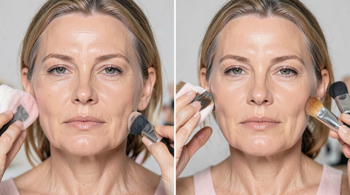
The method of application significantly impacts how foundation appears on mature skin, yet many people continue using techniques that worked in their younger years. Applying foundation with heavy brushes or kabuki-style tools often results in over-application and uneven density, particularly in areas prone to creasing. 7 These tools can pick up excessive product and press it into fine lines rather than creating an even, translucent layer. Similarly, using fingers to apply foundation everywhere creates inconsistent pressure and coverage density; while fingers can work for blending, they lack the precision control needed for mature skin.
Expert makeup artists recommend using damp sponges or lightweight brushes for initial application, followed by finger-blending in delicate areas. 8 The damp sponge absorbs excess product and helps foundation meld with skin rather than sitting on top as a visible layer. Building coverage gradually through thin layers prevents the heavy, mask-like effect that draws attention to aging. Application should begin at the center of the face and blend outward with decreasing product amount, creating natural gradation that enhances rather than masks facial structure. Spending time on application technique yields better results than expensive product formulations alone.
Over-Powdering and Setting Product Mistakes
Powder application represents another critical error point for mature skin. Many women apply setting powder liberally across the entire face, a technique that emphasizes every texture, crease, and fine line by settling into these areas and creating a visible, caked appearance. 9 Powder particles concentrate in natural facial creases and expression lines, actually making wrinkles appear deeper and more pronounced. The powder also absorbs any remaining skin luminosity, leaving a dry, tired appearance that contradicts the goal of looking refreshed and youthful.
Dermatologists recommend using powder extremely sparingly or skipping it entirely in areas with visible lines, such as around the eyes, across the forehead, and in nasolabial folds. 10 If setting is necessary, use a light hand and apply only to truly oily zones, such as the T-zone. Many experts suggest using a setting spray instead of powder to lock foundation in place without the texture-emphasizing effect of powder particles. For those who prefer a matte finish, choosing a natural matte foundation formula eliminates the need for additional powder and reduces the overall product load sitting on mature skin.
Failing to Account for Skin Texture Changes and Hydration Needs
Perimenopause and menopause trigger dramatic shifts in skin behavior that many women do not adequately address in their foundation routine. During the first five years of menopause, collagen synthesis declines by approximately 30 percent, leading to changes in skin texture, elasticity, and moisture-holding capacity. 11 Skin becomes thinner, more textured, and increasingly prone to dryness. Maintaining a foundation routine designed for younger skin ignores these fundamental biological changes and guarantees poor results.
Rather than fighting these changes with heavier products, dermatologists recommend working with them through intentional formula selection and application strategy. Foundations must deliver hydration alongside color correction, incorporating ingredients like niacinamide, peptides, or antioxidants that support skin health while providing coverage. 12 Lightweight, breathable formulas that feel comfortable and non-suffocating outperform heavy-duty long-wear products that prevent skin from functioning properly. Additionally, adjusting foundation shade and undertone as skin changes helps maintain a natural appearance despite shifting complexion tone during hormonal transitions.
Not Building Coverage Strategically in Problem Areas
Rather than applying foundation uniformly across the entire face, dermatologists recommend a strategic approach that uses more coverage where needed and less elsewhere. 13 Many women either over-apply foundation everywhere or under-apply everywhere, missing the opportunity to customize coverage based on individual skin patterns. The goal is to even out skin tone and texture while maintaining natural facial contours and light reflection, not to create a flat, uniformly covered surface.
The most effective mature skin foundation application concentrates product in areas requiring true color correction, such as around the nose, chin, and any hyperpigmented spots, while using nearly sheer application across cheeks and forehead where skin tone is relatively even. 14 Applying foundation from the center of the face outward with decreasing product amount creates a subtle gradient that looks natural and three-dimensional. This technique requires practice but produces results that appear fresh rather than obviously makeup-covered, which is particularly important for mature complexions where obvious makeup application can age the appearance.
Sources
- Beauty Empties: 7 Foundation Mistakes That Age You After 50
- Byrdie: The 10 Best Foundations for Mature Skin of 2026
- Glamour: How to Apply Makeup for Older Women, According to Pro Makeup Artists
- Good Housekeeping UK: Sophie, Duchess of Edinburgh Youthful Skin Makeup Swap
- Glow Over 50: How to Stop Foundation Separating on Mature Skin
- Vogue: The Best Makeup for Women Over 50
- InStyle: The 19 Best Foundations for Mature Skin, Tested & Reviewed
- British Vogue: A New Generation Of Matte Foundations Has Arrived
- The Holly Hughes Podcast: Makeup Over 40 Why Your Old Routine Stops Working
- Prevention Magazine via Facebook: Dermatologists Say These Are the Best Foundations for Mature Skin
- Dr. Mamina Turegano Podcast: The Truth About Botox, Sunscreen & Skin Aging After 40
- Dr. Denese: Glow Younger Vitamin C Foundation Product Information
- La Brunette Shop: Je suis maquilleuse et voici les 5 erreurs qui vieillissent le plus les femmes après 50 ans
- Clin d'Oeil: Cette erreur maquillage nous fait paraître plus vieille