3-night Quebec City rail-and-stay trip with train tickets and hotel included: A practical planning analysis
A 3-night Quebec City rail-and-stay trip with train tickets and hotel included generally combines a VIA Rail Corridor journey, three hotel nights, and independently arranged sightseeing or local transportation. Quebec City’s Gare du Palais provides the rail arrival point, while Old Quebec, Saint-Roch, and the Parliament Hill area offer practical bases for a short visit. 1 2
How a three-night itinerary is normally structured
A four-day schedule commonly places arrival and initial Old Quebec exploration on the first day, a full sightseeing day on the second, a third day for additional city touring or an excursion, and departure on the fourth day. This structure leaves enough time for the fortified historic district while avoiding an itinerary dominated by transfers. Old Quebec is the principal sightseeing base for first-time visitors and is walkable from many central hotels. 3
The exact sequence depends on the rail origin and departure timetable. A traveler arriving from Montreal can use the first afternoon for check-in and a Lower Town walk, then reserve the second day for historic landmarks and the third for museums, river viewpoints, or an out-of-center visit. A late train arrival may require shifting the most time-sensitive sightseeing to the following morning.
Rail tickets and Gare du Palais logistics
VIA Rail serves Quebec City through Gare du Palais, the city’s passenger rail station. Train schedules, journey times, and fares vary according to travel date and fare class, so a ticket-inclusive package does not represent one uniform travel product. The station’s central position makes it relevant to short stays, although the practical transfer method depends on hotel location, luggage, weather, and arrival time. 1 2
Rail-and-hotel arrangements should be checked for the precise ticket conditions attached to the itinerary. Important distinctions include whether the ticket is changeable, whether cancellation produces a refund or credit, and whether the hotel reservation follows separate rules. These terms can create the largest practical difference between a bundled arrangement and separate reservations, particularly when a train schedule changes or a room becomes unavailable.
Choosing a hotel area
Old Quebec places visitors close to the fortified district, historic streets, restaurants, and major architectural sights. Fairmont Le Château Frontenac is a landmark accommodation in Old Quebec, while its location illustrates why the district is frequently selected for short stays. 5 Saint-Roch can provide a different urban setting with access toward the station and central streets, and the Parliament Hill area is another practical base for visitors prioritizing central access.
Full-service downtown accommodation also exists outside the historic core. Delta Hotels by Marriott Quebec is one example of a central hotel category that differs from a heritage property in setting and accommodation style. 6 A comparison should examine walking distances, room type, breakfast arrangements, taxes, cancellation deadlines, luggage handling, and any transportation included between Gare du Palais and the hotel rather than relying only on the hotel name.
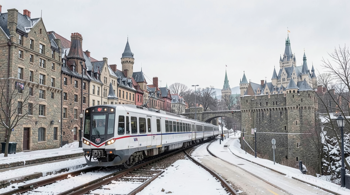
A practical sightseeing plan
Day one can focus on orientation through Old Quebec, including the Upper Town and Lower Town, with the historic fortifications providing a central framework for understanding the city. Parks Canada identifies the Fortifications of Québec as a nationally significant historic site associated with the historic city. 7 The Old Quebec Funicular can assist movement between upper and lower areas, which may be relevant when walking conditions, luggage, or mobility needs make steep routes less suitable. 3
Day two is suited to concentrated city touring, while day three can accommodate a slower neighborhood itinerary or an attraction beyond the immediate historic district. The local bus network is operated by the Réseau de transport de la Capitale, although walking may be sufficient for Old Quebec and nearby landmarks. 4 A rail-and-stay plan should distinguish included sightseeing from optional activities because admissions, guided tours, meals, and local transportation may not be part of the rail or hotel component.
What “included” can mean in package descriptions
Package wording requires careful interpretation. A documented Montreal and Quebec City itinerary describes four nights and five days, customizable trip length, hotel accommodation, private transfers, and VIA Rail Business Class travel between the two cities. 11 That example demonstrates how a rail-and-stay format may include upgraded rail service and transfers, but it does not establish the inclusions or duration of every three-night Quebec City arrangement.
Separate research describes a five-day Montreal and Quebec City train trip beginning at 3,450 Canadian dollars, while longer Eastern Canada rail itineraries list substantially different durations and starting prices. 12 Such figures are itinerary-specific rather than a universal three-night rate. Travelers should request an itemized breakdown showing rail fare class, three hotel nights, taxes, transfers, meals, sightseeing, and cancellation conditions before treating the word “included” as comprehensive.
Seasonal, documentation, and booking considerations
Quebec City has substantial seasonal variation. Winter conditions can involve cold and snow, while summer is associated with higher visitor demand, so clothing, footwear, walking plans, and hotel availability require date-specific consideration. Environment and Climate Change Canada publishes Quebec City weather observations and forecasts that can support this planning. 10 The season also affects the comfort of walking between the station, hotel, and Old Quebec attractions.
Canadian citizens and permanent residents should carry appropriate identification, while international visitors should verify current entry-document requirements before booking. Government of Canada travel guidance explains documents that may be required, and Destination Canada provides broader visitor-planning information. 8 9 The principal risks are mismatched cancellation policies, nonrefundable rail conditions, seasonal disruption, room substitutions, and assumptions that local sightseeing or station transfers are automatically included.
Sources
- VIA Rail Canada, Quebec City destinations and trains: https://www.viarail.ca/en/explore-our-destinations/trains/quebec-city
- VIA Rail Canada, Quebec City station: https://www.viarail.ca/en/explore-our-destinations/stations/quebec-city
- Quebec City Tourism, Old Quebec: https://www.quebec-cite.com/en/what-to-do/old-quebec
- Réseau de transport de la Capitale: https://www.rtcquebec.ca/en
- Fairmont Le Château Frontenac: https://www.fairmont.com/frontenac-quebec/
- Delta Hotels by Marriott Quebec: https://www.marriott.com/en-us/hotels/yqbdl-delta-hotels-quebec/overview/
- Parks Canada, Fortifications of Québec: https://parks.canada.ca/lhn-nhs/qc/fortifications
- Destination Canada: https://travel.destinationcanada.com/en-ca
- Government of Canada travel guidance: https://travel.gc.ca/travelling/visas
- Environment and Climate Change Canada weather information: https://weather.gc.ca/city/pages/qc-22_metric_e.html
- Canada Revealed, Montreal and Quebec City Getaway: https://www.canadarevealed.ca/trip/montreal-quebec-city-getaway/
- Canadian Train Vacations, Montreal to Quebec City train information: https://canadiantrainvacations.com/explore/montreal-train