The best forested retreats to explore for wildlife observation in 2027: A research guide
Forested retreats to explore for wildlife observation in 2027 range from private sanctuary settings near Indian national parks to community-managed lodges deep in the Amazon. The strongest choices are distinguished by habitat protection, access to experienced guides, and a realistic understanding that wildlife sightings remain seasonal and uncertain.
How to assess a forested wildlife retreat
A useful comparison begins with the surrounding ecosystem rather than the accommodation category. Tipai is positioned at the gateway to Tipeshwar Wildlife Sanctuary and sits within a 34-acre setting, while Gocta Natura Reserve occupies 82 hectares of protected cloud forest beside Gocta Falls. These locations illustrate two different models: a retreat adjoining an established wildlife sanctuary and a rewilding project actively restoring former pasture into forest habitat. 1 4
Wildlife value also depends on the range of habitats available during a stay. Tipeshwar is described as a biodiversity hotspot with the Royal Bengal tiger, pangolin, panther, nilgai, more than 180 bird species, and 26 reptile species. Gocta’s Andes to Amazon transition supports birds, monkeys, orchids, and recovering forest communities. Such diversity can provide broader observation opportunities than a retreat focused on one flagship species. 1 4
Indian forest retreats for mammals and birds
Tipai offers a wildlife-oriented setting near Tipeshwar in Maharashtra, approximately 170 kilometres from Nagpur according to the retreat’s published description. Its stated wildlife range extends beyond tigers to include pangolins, panthers, nilgai, birds, and reptiles, making it relevant for observers who want a mixed-species itinerary rather than a tiger-only focus. Forest villas and pool residences are part of the property format, but the central ecological attraction is access to the sanctuary landscape. 1
In Rajasthan, Chokhiwadi Forest Retreat borders Sariska National Park in the Aravalli foothills. The property reports that more than 500 acres are reserved for organic food forests and farm-to-table gardens, and that more than 20,000 native trees were planted across its original 9.5-acre development area. Listed activities include guided nature walks, trekking, birdwatching, stargazing, and wildlife safaris. Satpura Jungle Retreat near Satpura National Park similarly frames its offer around safaris, nature escapes, photography, and forest-based experiences. 6 8
Amazonian retreats in Ecuador and Peru
Napo Wildlife Center is located inside Ecuador’s Yasuní National Park and is described as the only lodge inside the park. It is owned and operated by the Kichwa Añangu Community, which links tourism income with conservation, health, education, and community well-being. Published itineraries range from four days and three nights to seven days and six nights, with separate formats for birdwatching, guided excursions, photography, and cultural encounters. 2
Kuaii Amazonas provides a contrasting Peruvian Amazon model connected to the Tambopata National Reserve. The retreat is developed in partnership with the Ese Eja Native Community of Infierno, with stated objectives involving education, conservation, cultural heritage, and community-led tourism. Access includes a flight to Puerto Maldonado, approximately one hour by road, and then a further journey to the rainforest setting. That layered transfer is a practical consideration for visitors comparing remote forest locations. 3
Brazilian rainforest and Andean cloud-forest options
Cristalino Lodge is located inside the 11,399-hectare Cristalino Private Natural Heritage Reserve near Alta Floresta in Mato Grosso, Brazil. The lodge stands beside the clear Cristalino River, and the surrounding forest corridor is noted for substantial bird and primate diversity. Its conservation setting and trails make it particularly relevant to travelers interested in structured rainforest observation, while the reserve boundary provides a clearer ecological context than an urban-edge jungle property. 5
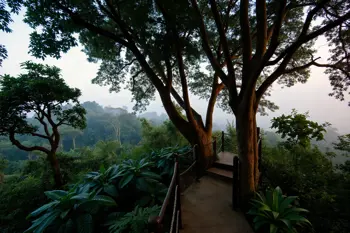
Gocta Natura Reserve in Peru presents a smaller-scale alternative centered on cloud-forest restoration. Six cabins are designed to blend into the trees, and the reserve combines forest exploration with journeys related to Chachapoya archaeology, history, and living traditions. The project began on land that had been pasture and is described as gradually returning to forest, creating habitat for birds, monkeys, orchids, and species associated with the Andes-Amazon transition. 4
Iwokrama and the value of large intact rainforest
Iwokrama Rainforest in central Guyana is described as a 371,000-hectare block of intact rainforest founded in 1996 and co-managed with Indigenous Makushi communities. The published biodiversity figures include 130 mammals, more than 500 birds, more than 420 fish, and 86 bat species, identified as a world record for a protected area. These figures make Iwokrama distinct from smaller retreats where observation is concentrated around a lodge, trail, or reserve boundary. 7
Its signature observation formats include a 154-metre canopy walkway at Atta, dawn and dusk drives along the forest road, night caiman cruises, and the Turtle Mountain climb. Wild jaguar observation is a major draw, but the available information emphasizes that dense forest makes sightings a matter of chance rather than a guarantee. The same principle applies across all wildlife retreats: habitat quality improves the possibility of encounters, but it cannot make animal behavior predictable. 7
Planning and responsibility for 2027
Travel formats vary substantially. Napo lists four-, five-, six-, seven-, and eight-day programs, including birding and cultural combinations. Iwokrama guidance identifies late August to November and February to April as its stronger dry-season periods, while the Kuaii Amazonas page displays a May 2027 check-in example. These details indicate why a 2027 itinerary should be matched to target species, rainfall patterns, transfer time, and the number of observation days rather than selected solely by retreat design. 2 3 7
There are also practical and ethical constraints. Remote rainforest access can involve flights, long road journeys, river transfers, humidity, insects, uneven trails, and limited connectivity. Sitio Cotinga in Brazil’s Atlantic Forest is specifically described as having no Wi-Fi in its chalet setting, while its high-altitude forest experience included Long-trained Nightjars observed at dusk. Responsible observation requires following guide instructions, maintaining distance from animals, avoiding disturbance during nesting or nocturnal activity, and evaluating whether tourism revenue demonstrably supports habitat or local communities. 9
Sources
- Wildlife Luxuries, Tipai
- Napo Wildlife Center, Ecuadorian Amazon Experience
- Rainforest Expeditions, Kuaii Amazonas
- Gocta Natura Reserve
- My Brazil Stay, Cristalino Lodge overview
- Chokhiwadi Forest Retreat
- EcoVoyager, Iwokrama Rainforest guide
- Satpura Jungle Retreat
- Brazil Birding Experts, Sítio Cotinga