The best hairstyles that rejuvenate after 60: An evidence-informed style guide
For women seeking the best hairstyles that rejuvenate after 60, current stylist guidance centers on modern shape, movement, manageable length, and hair health rather than disguising age. Expert coverage repeatedly identifies jaw-to-shoulder cuts, textured bobs, soft layers, wispy fringe, and carefully placed volume as adaptable choices for changing density and texture. 1
Why length and shape matter after 60
Hair commonly becomes finer, drier, or less dense with age, with thinning often noticed around the crown. The most adaptable range is generally from the jawline to the shoulders because it can balance facial proportions, preserve movement, and remain easier to style than very long hair. A cut should be selected according to density, curl pattern, face shape, and the amount of daily styling a person is prepared to manage. 2
| Cut characteristic | Potential visual effect |
|---|---|
| Jaw-to-shoulder length | Frames the face without excessive weight |
| Blunt perimeter | Can make fine ends appear denser |
| Strategic layers | Add movement without removing too much fullness |
| Side part | Creates a lifted appearance at the crown |
Textured bobs and collarbone cuts
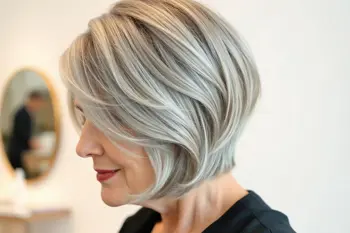
A textured bob is among the most consistently recommended options for hair that looks flatter or thinner. Chin-length and jaw-length versions create a defined outline, while light internal texture prevents the style from appearing rigid. A collarbone cut offers more versatility for waves and updos, but it should retain enough weight at the ends to avoid a sparse appearance. These shapes can be worn polished, softly waved, or air-dried with minimal manipulation. 3
- Choose a chin-length bob for a compact, face-framing silhouette.
- Choose a collarbone cut when tying the hair back or wearing waves is important.
- Request restrained layering if the hair is fine or visibly sparse.
Layered crops, shags, and pixie-bob shapes
Short layered cuts can create lift at the crown and reduce the effort required to establish shape. A layered bob or bixie, which combines features of a bob and pixie, is identified as a practical option because it can soften the face while retaining useful length around the sides. A shag can add movement to thick or naturally wavy hair, although excessive layering may make fine ends look thinner rather than fuller. 4
The shag is particularly dependent on placement. Face-framing layers beginning near the cheekbones can add movement while preserving density below, but a stylist should assess the hair’s natural fall before removing bulk. A soft pixie may suit someone seeking a shorter routine, yet it requires regular reshaping to maintain its intended outline. The appropriate choice is therefore based on texture and maintenance tolerance, not age alone.
Fringe and face-framing details
Wispy fringe can soften the forehead and make a haircut appear lighter than a dense, straight-across fringe. Curtain-style or side-swept bangs also create visual movement around the eyes and cheekbones, while face-framing pieces can prevent a medium-length cut from appearing heavy. Bangs require an assessment of growth direction, cowlicks, hairline density, and willingness to arrange them after washing. 5
| Detail | Most relevant consideration |
|---|---|
| Wispy fringe | Lightens the front and allows some forehead visibility |
| Side-swept bangs | Works with an off-center part and adds asymmetry |
| Curtain bangs | Blend into longer face-framing layers |
| Cheekbone layers | Emphasize the upper face while adding movement |
Matching cuts to fine, thinning, curly, or thick hair
Fine or thinning hair generally benefits from shape rather than a large number of layers. Blunt ends, a controlled crown lift, and a length that can air-dry into place may create a fuller-looking outline. Curly or thick hair can support more graduated layering because removing selected weight allows natural texture to form. The central principle is to work with existing density instead of relying on heavy products, aggressive teasing, or heat that may increase dryness and breakage. 6
- Fine hair: consider a blunt bob, tapered lob, or soft pixie.
- Thinning crown: use controlled crown lift and avoid over-layering.
- Curly hair: use graduated layers that respect the curl pattern.
- Thick hair: remove bulk selectively rather than thinning every section.
Gray, silver, and dimensional color considerations
Gray or silver hair can appear more vibrant when the haircut reflects light through movement and a clean outline. Soft layers, waves, and carefully placed highlights or lowlights may add dimension, while balayage can blend gray transitions more gradually. Color decisions should account for porosity, dryness, prior chemical processing, and maintenance capacity. A rejuvenating appearance is not dependent on concealing gray; shine, condition, and a suitable shape can be equally influential. 7
Hair health remains a practical limitation. Aging hair may be more vulnerable to dryness, breakage, and loss of elasticity, so repeated heat styling or aggressive chemical services can undermine the appearance a cut is intended to create. Moisture-focused care, gentle handling, and realistic expectations about density are more sustainable than attempting to produce permanent volume through intensive styling.
Maintenance, salon communication, and realistic expectations
A low-maintenance cut is defined by how well it holds its shape as it grows, air-dries, and performs with limited product, not simply by how short it is. Blunt edges, crown structure, and an appropriate length can reduce daily work for fine hair. Before a haircut, useful information includes natural texture, usual part, areas of thinning, preferred drying method, and the maximum time available for styling. 8
- Ask for the finished length in relation to the jaw, neck, or collarbone.
- Explain whether the hair is normally air-dried, diffused, or blow-dried.
- Specify whether fullness or reduced bulk is the primary goal.
- Discuss how the cut will look during grow-out and how often reshaping is needed.
How to evaluate a rejuvenating hairstyle
The most useful evaluation is whether the style improves balance, movement, and manageability without creating new maintenance problems. A suitable cut should preserve enough density at the perimeter, respond predictably to the wearer’s natural texture, and frame the face without forcing a rigid youthful effect. Photographs can communicate shape, but the final result still depends on density, curl pattern, hairline, and the stylist’s adaptation to individual features.
In practical terms, the strongest choices after 60 are not limited to one universal haircut. A textured bob may support fine hair, a layered collarbone cut may suit someone wanting flexibility, a carefully controlled shag may enhance waves, and a soft pixie may reduce styling time. The shared elements are proportion, selective layering, healthy ends, and a design that reflects the wearer’s present hair rather than an earlier texture.
Sources
- Who What Wear, “The 9 Best Hairstyles for Women Over 60 in 2026, Per Experts”
- Prevention, “20 Anti-Aging Haircuts for Women Over 60 to Help You Look and Feel Your Best”
- Parade, “7 Best Hairstyles for Thin Hair Over 60, According to Top Stylists”
- Daily Hair Inspo, “20 Best Short Layered Haircuts for Women Over 60”
- AOL, “The 9 Most Flattering Bob Haircuts for Women Over 60 With Thinning Hair”
- SheFinds, “9 Anti-Aging Hairstyles Mature Women Should Try This Autumn”
- VWC News, “Fine Hair After 60: This Haircut Is the Best for Adding Volume”
- Numi Hair, “Low-Maintenance Hairstyles for a 60-Year-Old Woman With Fine Hair”