Makeup mistakes to avoid after 50: An evidence-informed guide to mature-skin application
Makeup mistakes to avoid after 50 often begin with using the same techniques that worked in earlier decades. Changes in moisture, elasticity, skin texture, and facial structure can make heavy layers, overly matte finishes, and harsh placement appear less natural, while lighter, hydrating application can better enhance existing features.
1. Applying heavy or overly matte foundation
Full-coverage foundation is one of the most frequently identified problems for mature skin. Professional makeup artists report that heavy, full-matte formulas can settle into fine lines, pores, and expression marks instead of concealing them. Lightweight, hydrating, buildable formulas are generally more forgiving because they blend into the complexion and preserve a skin-like finish. Tinted moisturizers, serum-style foundations, BB or CC creams, and thin layers of liquid foundation are commonly suggested alternatives, with targeted concealer used only where additional coverage is needed. 1
- Prefer sheer to medium coverage when an even but natural complexion is the goal.
- Choose satin, radiant, or dewy finishes rather than fully matte textures when dryness is visible.
- Build coverage only on areas requiring correction instead of adding another layer across the whole face.
2. Skipping moisture and sun protection
Applying makeup over unmoisturized skin can make dryness and surface texture more apparent. The National Institute on Aging describes older skin as thinner, drier, and less elastic, while Cleveland Clinic guidance also emphasizes gentle cleansing and regular moisturization as skin becomes more sensitive. Sun protection is a separate but related preparation step: the American Academy of Dermatology recommends broad-spectrum, water-resistant sunscreen with SPF 30 or higher to help reduce ultraviolet damage associated with premature aging. 2 3 4
- Cleanse gently and allow moisturizer to settle before applying complexion products.
- Use sunscreen as part of daytime skin preparation, following the product’s directions.
- Avoid assuming that makeup alone provides sufficient protection from ultraviolet exposure.
3. Setting the entire face with powder
Powder can be useful in selected areas, but applying it heavily across the face may emphasize dryness, fine lines, and uneven texture. Laura Mercier’s professional guidance recommends limiting powder to areas that become shiny, commonly the forehead, nose, and chin, and keeping under-eye powder minimal. Other professional sources similarly describe excessive loose powder as a contributor to a cakey, flat appearance on mature skin. 5
| Application area | More controlled approach |
|---|---|
| Forehead, nose, and chin | Press a thin amount where shine or movement requires it. |
| Under-eyes | Use very little, since excess product can collect in creases. |
| Cheeks and dry areas | Leave the skin lightly set or use a minimal amount only when necessary. |
4. Using harsh or overly reflective color
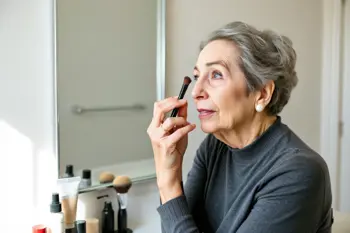
Completely avoiding shimmer, color, or expressive makeup is not medically required, but texture and placement matter. Glamour’s cited artists caution that full-matte products can grab onto lines, while highly glittery, metallic, or mica-heavy products may settle into creases and accentuate texture. A balanced finish with flexible, buildable color is more adaptable. Cream eye shadow can be easier to blend than dry powder, and softly reflective shades may be more forgiving than large particles of glitter or intense metallic pigment. 6
- Test reflective products in the lighting where the makeup will usually be worn.
- Use soft transitions instead of sharply contrasting blocks of color.
- Choose color according to personal preference, while observing whether particles collect in lines.
5. Creating harsh lines and low facial placement
Placement can change the visual balance of the face. Guidance summarized by Rolling Out identifies blush placed only on the apples of the cheeks as potentially emphasizing lower cheek hollowing, while positioning color higher toward the tops of the cheekbones and temples can create a more lifted impression. Similar caution applies to thick black liquid liner, dark visible lip borders, and sharply overdrawn brows, which can create strong contrast and make makeup appear rigid rather than integrated with the face. 7
- Blend blush upward and outward rather than concentrating it low on the cheeks.
- Consider softer brown, gray, blue, purple, or green eyeliner when those shades complement the eyes and overall coloring.
- Fill brows with small, hair-like strokes and soften the edges instead of creating a solid block.
- Use lip liner to define and contain lipstick, not as a dark border that dominates the mouth.
6. Ignoring product safety and skin sensitivity
Makeup technique is only one part of a mature-skin routine. The U.S. Food and Drug Administration advises consumers not to share eye cosmetics, to replace products contaminated during an eye infection, and to follow manufacturer guidance because eye-area products can contribute to infections. The American Academy of Ophthalmology also recommends keeping eyeliner away from the inner eyelid. Fragranced cosmetics can cause irritant or allergic contact dermatitis, according to DermNet, so reactive skin may require fragrance-free choices and patch testing when a new reaction is suspected. 8 9 10
- Discard eye makeup that has been contaminated or associated with an eye infection.
- Do not share mascara, eyeliner, eye shadow applicators, or other eye cosmetics.
- Avoid applying liner directly along the inner eyelid or waterline.
- Stop using a product that causes burning, swelling, itching, or persistent redness and seek clinical advice when symptoms continue.
A practical review of an existing routine
A useful assessment does not require abandoning makeup or following rigid age rules. Sandy Linter, a veteran makeup artist cited by Beauty Bism, argues that makeup should enhance rather than conceal and that there are no universal rules. AGEIST likewise notes that changes in moisture and reflectiveness can cause products that once melted into the skin to sit visibly on top of it. The practical test is whether each product remains comfortable, blends evenly, and supports the intended feature without exaggerating dryness or texture. 11 12
| Observed issue | Likely adjustment |
|---|---|
| Foundation gathers in lines | Reduce the amount and switch to a hydrating, buildable finish. |
| Complexion looks chalky | Reduce powder and reassess whether the foundation is too matte. |
| Eyes look weighed down | Soften liner, avoid a thick liquid wing, and blend shadow carefully. |
| Skin feels tight or irritated | Review preparation, fragrance exposure, exfoliation, and product safety. |
Sources
- Glamour, “How to Apply Makeup for Older Women, According to Pro Makeup Artists”
- National Institute on Aging, “Skin Care and Aging”
- Cleveland Clinic, “Skin Care Over 50”
- American Academy of Dermatology, sunscreen application guidance
- Laura Mercier, “Makeup Mistakes That Make You Look Older and How to Fix Them”
- Glamour, professional guidance on matte and shimmer formulas
- Rolling Out, “5 Most Common Makeup Mistakes Aging People”
- U.S. Food and Drug Administration, “Eye Cosmetics and Eye Makeup Safety”
- American Academy of Ophthalmology, eye makeup safety guidance
- DermNet, “Cosmetics and Skin Reactions”
- Beauty Bism, “A Guide to Ageless Makeup for Women Over 50”
- AGEIST, “Makeup Tips for Women Over 50”