Tennis elbow recovery: which physiotherapist-recommended solutions may help? An evidence review
Understanding tennis elbow and its recovery pattern
Tennis elbow, more precisely called lateral elbow tendinopathy or lateral epicondylalgia, affects the wrist extensor tendons at the outside of the elbow. The extensor carpi radialis brevis, or ECRB, is commonly identified as the primary tendon involved. Pain may appear during gripping, lifting, shaking hands or extending the wrist. Despite its name, the condition is not limited to tennis players and is associated with repetitive work, typing, tools, gym activity and other loading tasks. 1
The condition is generally understood as a tendinopathy rather than a straightforward inflammatory injury. Tissue findings described in the supplied physiotherapy evidence include disorganised collagen, micro-tears, vascular in-growth and fibroblast activity, with no notable classic inflammatory pattern. Symptoms often settle over several months, sometimes without specialised treatment, although stretching and strengthening may help recovery occur faster. Improvement is usually gradual rather than immediate. 2
Progressive strengthening as the central solution
Physiotherapists commonly place progressive loading at the centre of rehabilitation because the tendon must gradually regain tolerance to gripping and wrist-extension forces. Eccentric wrist-extension exercises involve lowering the wrist slowly against resistance, while isometric exercises hold the muscle under tension without visible movement. The supplied clinical material identifies eccentric and isometric strengthening as the area where evidence is strongest, particularly for reducing pain and improving tendon capacity compared with rest alone. 3
A FlexBar-based eccentric programme is specifically highlighted in the CK Physio review as producing the largest strength gains among the exercise approaches discussed. Exercise selection, resistance, repetitions and progression still require individual adjustment because pain severity, occupational demands and baseline strength differ. A physiotherapist may therefore begin with tolerable static loading, then introduce controlled movement and finally more demanding gripping, lifting or racquet tasks. The objective is measured adaptation, not forcing through severe pain. 1
Activity modification, stretching and ergonomics
Activity modification is usually intended to reduce aggravating load temporarily rather than impose complete rest. Repetitive gripping, forceful wrist extension, heavy lifting, prolonged mouse use and tool work may be adjusted through shorter periods, lighter loads, altered hand positions or additional recovery time. The supplied physiotherapy guidance describes this approach as foundational because passive rest alone does not rebuild the tendon’s ability to tolerate work or sport. 7
Wrist-extensor stretching may be prescribed to address restricted movement and reduce the immediate demand placed on painful tissues. Ergonomic assessment can also examine workstation positioning, keyboard and mouse use, tool handling or tennis equipment, including racket-grip considerations. These changes are particularly relevant when symptoms repeatedly return after rehabilitation. A graduated return-to-sport or work plan allows load to increase in stages, with symptoms monitored between sessions rather than judged only during the activity itself. 9
Bracing and hands-on physiotherapy
A counterforce brace or elbow strap may be suggested to redistribute forces away from the painful tendon attachment during selected activities. The Mayo Clinic information cited in the research payload identifies counterforce bracing as a tool that may relieve stress on the injured tendon. A brace is generally a symptom-management aid, not a replacement for strengthening, load modification or assessment of the activity that caused the overload. Comfort, placement and duration of use should be reviewed by a clinician. 4
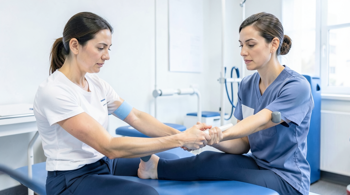
Soft-tissue mobilisation, massage and other manual techniques are also used by physiotherapists to manage forearm muscle tension and provide short-term symptom relief. However, the evidence supplied does not support treating massage as a stand-alone solution that restores tendon capacity. Quincy Physical Therapy summarises passive care as potentially helpful for symptoms while emphasising that progressive strengthening is more important for addressing the underlying loading problem. This distinction helps explain why relief after hands-on treatment may not equal full recovery. 7
Pain relief and treatments requiring caution
Ice packs are frequently advised for short periods, such as 15 to 20 minutes, when pain is irritated after activity. This approach is aimed at comfort and does not rebuild the tendon. Topical non-steroidal anti-inflammatory gel may improve pain by about 1.6 points out of 10 at four weeks compared with placebo gel, according to the evidence summary supplied by Quincy Physical Therapy. Evidence for oral non-steroidal anti-inflammatory drugs is described as uncertain, with possible gastrointestinal side effects. 7
Corticosteroid injection deserves particular caution. The CK Physio evidence summary reports a one-year recurrence rate of 54 percent after corticosteroid injection compared with 12 percent after placebo, based on the cited Coombes JAMA 2013 study. The same source states that injection produced worse outcomes at 12 months than doing nothing. Short-term pain reduction can therefore be misleading if it encourages rapid return to the same tendon load before strength and tolerance have improved. 1
Shockwave therapy, referral and safety considerations
Shockwave therapy is generally discussed as an option for refractory cases rather than as the first step for newly developed symptoms. The supplied CK Physio material reports an 89 percent success rate at 52 weeks in refractory cases from a study attributed to Rompe. A 2026 network meta-analysis in Frontiers in Pain Research examined short-term outcomes, defined as three months or less, across physical and micro-invasive interventions using pain, DASH function and PRTEE measures. Such findings require interpretation in relation to the individual diagnosis and treatment programme. 10
Clinical assessment is important when symptoms are severe, persistent, spreading, associated with numbness or weakness, or linked to an injury. The supplied hospital guidance states that evaluation may include imaging and discussion of additional care when conservative treatment has not helped. Recovery also has practical maintenance requirements: strengthening must continue as activity rises, work or equipment triggers may need correction, and sudden increases in training can provoke recurrence. A physiotherapist can distinguish expected exercise soreness from a pattern requiring reassessment. 4
What a structured recovery plan may contain
A typical physiotherapy plan may combine education, temporary activity adjustment, pain-monitoring guidance, stretching and progressive resistance. Early loading can use isometric holds, followed by eccentric wrist extension and more functional gripping or lifting. The programme is then adapted to the person’s work, sport and daily activities. The objective is not merely pain reduction, but improved grip strength, better tolerance of repeated loading and a controlled return to normal tasks. 5
Timeframes vary according to symptom duration, severity, tendon capacity and the demands being resumed. The supplied sources describe improvement as occurring over weeks to months, while some persistent cases can last 12 to 24 months. Recurrence figures reported in the research payload reinforce the importance of progressive rehabilitation rather than relying on rest or temporary symptom suppression. Physiotherapist guidance is most useful when exercises and workload changes are reviewed as function improves. 6
Sources
- CK Physio, Tennis Elbow Physiotherapy: Evidence-Based Exercises and Recovery, https://ckphysio.co.uk/blog/5-physiotherapy-exercises-tennis-elbow-rehabilitation
- NCBI InformedHealth.org, Tennis elbow and golfer’s elbow: How are they treated?, https://www.ncbi.nlm.nih.gov/books/NBK507012/
- Doctors of Physical Therapy, Tennis Elbow Physical Therapy: 4 Proven Treatments, https://doctorsofphysicaltherapy.com/orthopedic/tennis-elbow-physical-therapy/
- Mayo Clinic information as supplied through the research payload, https://www.mayoclinic.org/diseases-conditions/tennis-elbow/diagnosis-treatment/drc-20351987
- Acibadem Hospitals Group, Physiotherapy Treatment Tennis Elbow Guide, https://acibademinternational.com/health-library/physiotherapy-treatment-tennis-elbow-diagnosis-outlook-and-modern-treatment-approaches/
- Benchmark Physio, Tennis Elbow: An Evidence-Based Clinical Guide, https://www.benchmarkphysio.com/blog/tennis-elbow-an-evidence-based-clinical-guide-to-diagnosis-and-recovery-2026/
- Quincy Physical Therapy, Managing Tennis Elbow, https://quincypt.com/managing-tennis-elbow-lateral-epicondylitis/
- PhysioCare Physiotherapy, How Physiotherapy Can Help You Recover, https://www.physiocarephysiotherapy.com/blogs/tennis-elbow-physiotherapy-treatment-recovery/
- NHS, tennis elbow guidance as supplied in the research payload, https://www.nhs.uk/conditions/tennis-elbow/
- Frontiers in Pain Research, Short-term efficacy of physical interventions for lateral epicondylitis, https://www.frontiersin.org/journals/pain-research/articles/10.3389/fpain.2026.1855508/full