Improving joint mobility for mature adults: practical approaches for 2026 | Evidence and safety review
Why mobility deserves attention after 60
Joint mobility refers to the ability to move a joint through a usable range with control, coordination, and stability. For adults aged 65 and older, the CDC recommends combining aerobic activity, muscle-strengthening activity, and balance exercises each week, while also recognizing that activity should match individual abilities and medical conditions. The agency lists at least 150 minutes of moderate aerobic activity, or an equivalent amount of vigorous activity, alongside strengthening on two or more days and balance work. 1
Stiffness commonly affects the neck, hips, shoulders, spine, and ankles. A 2026 rehabilitation guide describes neck range-of-motion work as one practical way to address cervical stiffness, particularly when arthritis, sustained posture, or limited movement contributes to discomfort. Another mobility source argues that inactivity and repeatedly using only a narrow range can reduce access to movement, although structural conditions such as arthritis may also contribute. 2 3
Mobility is more than passive flexibility
Flexibility generally describes how far a muscle or joint can be moved passively, whereas mobility involves actively controlling the available range. This distinction matters for mature adults because a position may be reachable when assisted but difficult to use safely during walking, dressing, stair climbing, or standing from a chair. A mobility routine therefore needs both range-of-motion practice and sufficient strength to control the movement. 4
Movement sequences can be more functional than isolated stretches because several regions work together during everyday tasks. The reported examples include squat, deadlift, and push-up patterns, adapted as necessary for ability and safety. For people who sit for long periods, regularly changing position and moving the hips, spine, shoulders, and ankles can address the restricted patterns associated with prolonged sitting. 4 5
A practical daily mobility routine
A short routine can begin with comfortable joint circles and controlled range-of-motion movements rather than forceful stretching. Suitable categories described in the supplied research include neck movements, thoracic-spine rotations, shoulder wall slides, hip rotations, hip-flexor stretches, ankle circles, ankle dorsiflexion, wrist movements, and supported squat variations. The range should remain comfortable, and the movement should be slow enough to maintain balance and control.
Consistency is a recurring theme across the 2026 material. One guide presents a daily five-minute mobility flow, while another describes 10 to 15 minutes of mobility work as a practical daily amount. These figures should be treated as routine examples rather than universal prescriptions. Short “movement snacks,” such as standing, walking briefly, or performing gentle joint movements between sedentary periods, may be easier to maintain than occasional lengthy sessions. 5 6
Combine mobility with strength and weekly activity
Range-of-motion practice alone does not address every factor affecting movement. The NHS guidance cited in the research identifies muscle-strengthening activity as an important part of later-life physical activity. Strengthening the legs, hips, back, abdomen, chest, shoulders, and arms can support the stability and control required to use joint range during daily activities. Exercises may include sit-to-stand practice, supported step patterns, resistance-band work, or other adaptations selected for the person’s capacity. 7
Nutrition may complement movement but should not be presented as a replacement for exercise or clinical care. The supplied Arthritis Foundation material discusses supplements and nutrition in the context of managing arthritis symptoms, including interest in omega-3 fatty acids. Evidence and suitability vary by product, dose, medication use, and diagnosis. A clinician or pharmacist should review supplements when anticoagulants, chronic disease, allergies, or other medicines are involved. 8
Balance, water exercise, and load management
Balance training is relevant to mobility because joint movement must be coordinated with postural control. The supplied Harvard Health source describes Tai Chi as a practice associated with functional balance and movement benefits in older adults. Senior-focused yoga may offer another adaptable option when positions are modified and performed with stable support. Proprioception-focused activities should be selected conservatively when there is a history of falls, dizziness, neuropathy, or substantial weakness. 9
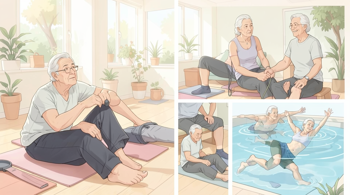
Aquatic therapy provides a different environment for people whose land-based movement is limited by pain or loading concerns. Mayo Clinic describes aquatic therapy as a method that can reduce joint loading while still allowing muscular engagement and movement. Weight management can also affect knee loading: Johns Hopkins reports that each kilogram of weight loss reduces stress on the knee joint by approximately four times during movement. These approaches still require individualized assessment and sustainable maintenance. 10 11
Safety, monitoring, and long-term maintenance
Mobility work should be adjusted when pain is sharp, symptoms worsen, balance becomes unreliable, or a joint repeatedly gives way. Stable chairs, walls, rails, or supervised settings can reduce fall exposure during standing exercises. New or severe swelling, unexplained weakness, sudden loss of movement, chest symptoms, or persistent pain warrants medical evaluation rather than continued experimentation. The research does not establish that every stiffness complaint is caused by disuse, so structural and inflammatory conditions must remain part of the assessment.
Physical therapy increasingly incorporates digital monitoring, including tools that track movement or joint-angle measures, according to the supplied Cleveland Clinic reference. Such technology can help document progress, but it cannot independently determine whether a movement is medically appropriate. The National Institute on Aging provides frameworks for beginning exercise programs, supporting gradual progression based on health status and ability. Long-term maintenance depends on repeating manageable movements, strength work, balance practice, and aerobic activity rather than relying on one intensive session. 12 13
Sources
- CDC, Older Adult Activity: An Overview, https://www.cdc.gov/physical-activity-basics/guidelines/older-adults.html
- MedAmerica Rehab Center, The Ultimate Guide: 8 Mobility Exercises for Older Adults in 2026, https://www.medamericarehab.com/mobility-exercises-for-older-adults/
- Motive Training, Mobility Training After 60, https://www.movewithpurpose.com/mobility-training-after-60
- Fit&Well, A mobility expert recommends these six stretches for older adults with especially stiff joints, https://www.fitandwell.com/exercise/flexibility/a-mobility-expert-recommends-these-six-stretches-for-older-adults-with-especially-stiff-joints
- FitBodySync, Daily Mobility For Joint Health, https://www.fitbodysync.com/bulletproof-joints-the-2026-daily-5-minute-mobility-flow/
- Longevity Our Way Magazine, A daily routine for better mobility and joint range of motion, https://longevityourway.com/a-daily-routine-for-better-mobility-and-joint-range-of-motion/
- NHS, Physical activity guidelines for older adults, https://www.nhs.uk/live-well/exercise/physical-activity-guidelines-for-older-adults/
- Arthritis Foundation, Supplement and Herb Guide for Arthritis, https://www.arthritis.org/health-wellness/treatment/diet-and-nutrition/supplements-vitamins/supplement-and-herb-guide-for-arthritis
- Harvard Health Publishing, The Health Benefits of Tai Chi, https://www.health.harvard.edu/staying-healthy/the-health-benefits-of-tai-chi
- Mayo Clinic, Aquatic Therapy, https://www.mayoclinic.org/tests-procedures/aquatic-therapy/about/pac-20384873
- Johns Hopkins Medicine, Weight Loss Relieves Knee Pain, https://www.hopkinsmedicine.org/health/conditions-and-diseases/arthritis/weight-loss-relieves-knee-pain
- Cleveland Clinic, Physical Therapy, https://my.clevelandclinic.org/health/treatments/23309-physical-therapy
- National Institute on Aging, How to Start an Exercise Program, https://www.nia.nih.gov/health/exercise-physical-activity/how-to-start-exercise-program