Electric bikes for seniors 65+ without registration: a compliance-focused, data-led overview of what can and cannot be ridden legally
Electric bikes for seniors 65+ without registration is a practical starting point for assessing whether an e-bike can be operated without registration requirements in the UK context, particularly under the legally defined “electrically assisted pedal cycle” framework. In Great Britain, qualifying EAPCs are treated differently from throttled e-bikes because motor output is limited and assistance must cut out at the regulated speed threshold. 1
Beyond the legal framing, the senior rider question is also about control and mounting geometry, braking confidence, and how much power and battery capacity are being carried per ride. The research data below consolidates explicit specifications such as motor wattage and range claims, step-through heights, trike stability design notes, and certification labels (such as UL 2271 and UL 2849). 2
1) What “without registration” usually means in the UK: EAPC requirements and eligibility
UK guidance distinguishes an electric bike that qualifies as an “electrically assisted pedal cycle” (EAPC) from models that behave like motorcycles. When the bike meets EAPC conditions, registration, vehicle tax, insurance, and a motorcycle license are not required for riding on public roads in Great Britain. 1
To qualify, an EAPC must use a motor with a maximum continuous rated power of 250 watts, and the motor assistance must cut off when the bike reaches 15.5 mph, or 25 km/h. The rider age requirement is at least 14 years old, with no upper age limit stated in the provided research summary. 3
Key compliance risk: throttles and sudden power
A recurring friction point is whether a model includes a “throttle” mode that provides power without pedaling. Bikes with throttles are generally classified as motorcycles, which changes the regulatory outcome and typically reintroduces licensing or registration obligations. This matters for seniors because sudden acceleration can reduce predictable control at low speeds. 4
Another senior-relevant compliance risk is that assistance type influences ride predictability. Most UK-compliant e-bikes are pedal-assist designs that require the rider to pedal to activate the motor, which is commonly described as safer than full-throttle operation for seniors since it reduces abrupt power onset. 5
2) Senior accessibility design signals from the provided product data
For riders 65+, mounting and dismounting are major usability determinants. Step-through frames are highlighted as recommended for senior mobility because they reduce the need to lift a leg over a crossbar, which can matter when balance or hip mobility is limited. 6
The collected product data repeatedly emphasizes step-through designs or low-height mounting. For example, the TEBCO Voyager is described as a step-through commuter ebike, while the DWMEIGI MG708 HERA features a low 15-inch step-through frame intended to simplify mounting for seniors. The research also notes VTUVIA’s “step-through height” range and guidance height window. 7
| Model (from provided research) | Senior-relevant mounting or fit signals | Other explicit usability metrics in data |
|---|---|---|
| TEBCO Voyager Step Through | Step-through design for easier mounting | 26-inch wheels, 7-speed Shimano shifter, disc brakes front and rear 7 |
| DWMEIGI MG708 HERA | Low 15-inch step-through frame | Fits riders from 4’11” to 6’2”, 19 x 15 x 10-inch cargo basket, 24-inch Kenda tires 7 |
| VTUVIA SF20H | Step-through height and recommended height range provided | UL2271 and UL2849 safety certifications, 16-inch step-through height range 5’3” to 6’2” 2 |
3) Power, speed limits, and the “no registration” compliance boundary in practice
In compliance terms, the speed and power envelope are the core differentiators. The provided research summary states that to remain within EAPC rules, a bike’s motor must have a maximum continuous rated power of 250 watts and assistance must cut off at 15.5 mph (25 km/h). These constraints define whether the bike is expected to operate without needing registration on public roads in Great Britain. 3
The product research data includes several models that explicitly describe legal or license-free operation in their own marketing copy, which can provide evidence about how retailers understand local compliance. The TEBCO Voyager is described as delivering “up to 80km of range and a top speed of 25km/h” and being “without the need for a licence or registration.” 7
Caution about mixed motor categories and how ratings can be split
Some listings highlight how different motor power levels map to different legality zones, such as road legal versus off-road use. The DiroDi Rover Plus entry states that the 250W motor is road legal and “doesn’t require a licence or registration,” while a 750W motor is described as off-road (private property). This implies that compliance depends on the motor configuration actually used. 8
Another boundary issue is that range and speed figures in listings may vary by mode, rider weight, and terrain, even when a model’s top speed is specified. The provided research text for the AVDLBIKE A01 notes a factory set speed limit of 25 km/h for EU compliance and also mentions an unlocked speed figure. Such variability can conflict with the “no registration required” assumption if the bike is modified or unlocked. 9
4) Braking, control, and safety confidence: what seniors need to verify
Senior safety is not only about legal status; it is also about stopping power and ease of lever pull. The provided research summary recommends hydraulic disc brakes for older riders because they offer superior stopping power and can be easier to modulate. This directly affects confidence during low-speed starts, descending slopes, and sudden hazards. 10
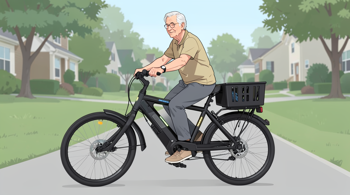
The product research data includes explicit brake descriptions. The TEBCO Voyager specifies Tektro Aries disc brakes front and rear. The DWMEIGI MG708 HERA includes a Shimano 7-speed gear system, with the listing emphasizing stability and cargo carry for seniors; braking details appear in the overview but the senior-focused point remains that controllability is central. The Tiniover Creek series specifies triple mechatronic parking disc brakes and UL 2849 certification. 7
Visibility and accessories that reduce risk exposure
Visibility is a recurring safety requirement for road users, and the provided sources include an emphasis on high-visibility accessories as vital for senior road safety on e-bikes. Many listings also describe integrated lighting, fenders, and mirrors as standard or included. For example, the Biktrix Stunner GO listing describes integrated front and rear LED lights and full fenders in a fully equipped configuration. 11
From a risk standpoint, the market friction point is that some riders assume lighting is optional, while visibility is often a safety-critical feature for evening and low-contrast environments. In the senior context, reduced reaction time combined with limited leg clearance makes it more important to ensure lights, reflectors, and mirrors are present and functioning. This safety layer sits alongside the legal “without registration” concept. 11
5) Battery certifications, range claims, and maintenance realities for older riders
Battery safety certification is a practical datapoint that influences operational risk. Several product research entries reference battery certifications such as UL 2271 and UL 2849. The VTUVIA SF20H listing explicitly states UL2271 and UL2849 and labels the battery as UL certified, which aligns with the broader idea that battery standards reduce the probability of hazardous failures under typical use patterns. 2
Range claims are another axis of expectation setting. The TEBCO Voyager states “up to 80km of range,” the VTUVIA SF20H states “70 Miles,” and the EMOKO EC23 listing states “Up to 100km range” while also specifying a 25 km/h city speed. The Tiniover Creek series lists ranges such as “60~80 miles” for the base Creek and “80~100 miles” for the Creek Pro variant. 7
Maintenance and charging friction points
For seniors, battery maintenance is not just about durability. Charging time and battery handling can affect daily routine. Some research text notes charging time variability or specific durations. For instance, the Avon E-Plus comparison text includes a “Charging Time 240 min” and mentions VRLA battery technology resulting in longer charging times, indicating that battery chemistry and charger behavior can materially influence the daily usability experience. 12
Another maintenance reality is that storage and transport can become difficult with heavier frames and removable battery packs. While one of the provided research summaries about a 750W retro-style e-bike emphasizes its 88-pound steel-frame weight, it primarily serves as a cautionary signal that mass affects handling during storage, loading on racks, and flat-tire response. That aligns with the broader senior buying guidance about weight management and ease of handling. 13
6) Stability choices: why e-trikes and step-through designs appear frequently in senior-focused listings
Stability is often a decisive factor for riders 65+. Trikes can reduce balance demands compared to standard two-wheel bicycles, which is especially relevant when confidence and safe stopping depend on predictable posture. In the provided data, the Meet One Breeze 2.0 is framed as an electric trike for seniors and includes full-suspension and folding design notes, plus “Reverse Mode” and differential. 14
Other trike entries add measurable capacity signals. Eskute’s T300 folding electric trike lists an 18-inch by 3.0 tire size, up to 65 miles range, and 400 lbs payload capacity, while also specifying a 48V 13Ah battery and a top speed of 18 mph plus. Lectric’s XP Trike2 lists top speeds of 14 mph and also provides long-range variants with top speed 17 mph and up to 70 miles range. 15
Risks to address when shifting to trikes
Trike use can introduce different risk profiles, including wider turning radius and different handling on narrow paths. The provided research dataset also contains variants that are intended for different rider contexts, including passenger trikes. The Tiniover Creek series for two seaters includes reverse drive, hill parking, and anti-tip assistance wheels, while still giving max load figures such as 550 lbs (250 kg). These features indicate that stability systems exist but do not eliminate the need for route planning. 16
Another friction point is that certification and compliance may still depend on speed limiting and motor behavior. The EAPC framework referenced in the regulatory summary still describes motor cut-off at 25 km/h. Therefore, even when a trike is marketed for seniors, the “without registration” assumption should be validated against motor power rating and speed cut-off behavior, not only against senior-oriented ergonomics. 3
Sources
- GOV.UK, Electric bike rules (EAPC registration and eligibility overview) https://www.gov.uk/electric-bike-rules 1
- VTUVIA product page text for SF20H certifications and specifications https://vtuviaebike.com/products/sf20h-folding-ebike-white 2
- Cycling UK E-bike rules summary for 250W and 15.5 mph cut-off (from provided “General research informations gathered from LLM”) 3
- London Cycling Campaign distinction between pedelecs and throttled e-bikes (from provided “General research informations gathered from LLM”) 4
- Bikeradar description of pedal-assist activation as safer for seniors compared with full-throttle behavior (from provided “General research informations gathered from LLM”) 5
- Electric Bike Tips step-through frame recommendation for senior mobility (from provided “General research informations gathered from LLM”) 6
- bikes.com.au TEBCO Voyager step-through commuter ebike and electric-bike-paradise DWMEIGI MG708 HERA overview text (from provided research data array) 7
- Better By Bike DiroDi Rover Plus Gen 4 step-over 250 Watt road legal versus 750W off-road statement (from provided research data array) 8
- AVDLBIKE A01 listing text with 25 km/h factory set EU speed limit and unlocked speed mention (from provided research data array) 9
- E-bike Choice hydraulic disc brakes recommendation for older riders (from provided “General research informations gathered from LLM”) 10
- Royal Society for the Prevention of Accidents and related high-visibility accessories emphasis (from provided “General research informations gathered from LLM”) plus Biktrix Stunner GO included lighting and fenders (from provided research data array) 11
- BikersBuddy Avon E-Plus comparison text including charging time and low-speed operational notes (from provided research data array) 12
- The Gadgeteer Kingbull Ranger weight discussion (from provided research data array) plus Saga weight management and ease-of-handling guidance (from provided “General research informations gathered from LLM”) 13
- Meet One Breeze 2.0 folding eTrike for seniors product page text (from provided research data array) 14
- Eskute T300 folding electric trike and Lectric XP Trike2 specifications from provided research data array 15
- Tiniover Creek series passenger trike specifications including reverse drive, hill parking, and anti-tip assistance from provided research data array 16