How to book a physiotherapy session with the NHS: A practical access guide
People searching for how to book a physiotherapy session with the NHS may be able to access specialist help for back, neck or joint pain without first booking a GP appointment. The route depends on the UK nation, local NHS service and type of condition, so self-referral is available in some areas but is not universal.
Check whether self-referral is available
In England, many NHS musculoskeletal services allow patients to refer themselves for problems affecting muscles, bones, joints and related nerves. Local pathways commonly cover back and neck pain, sciatica, sprains, strains, sports injuries, arthritis and joint stiffness. The NHS directs patients to local service information, while GP practice websites and reception teams may identify the relevant provider or a First Contact Practitioner, who is a physiotherapist based in primary care. 1 2
- Look for a local NHS musculoskeletal or physiotherapy self-referral form.
- Check whether the service has age, postcode, registration or condition-based eligibility rules.
- Ask the GP practice whether a First Contact Practitioner is available.
Use the GP referral route when required
If a local service does not accept self-referrals, a GP can assess the symptoms and refer to an NHS physiotherapy department or community musculoskeletal team. Referral may also come from a consultant, another doctor, a ward-based therapist or another healthcare professional, depending on the local arrangement. This route may be particularly relevant for persistent symptoms, post-operative rehabilitation, complex injuries or mobility problems requiring wider clinical assessment. 2 10
A GP appointment is not automatically a physiotherapy booking. The clinician may recommend exercises, provide self-management advice, request further assessment or refer to a different service if physiotherapy is not the most suitable pathway. The receiving NHS department normally reviews the referral and explains the next administrative step, which can involve a letter, telephone contact or an online appointment process. 2 6
Find the correct local NHS service
The practical booking instructions are set locally rather than through one single UK-wide physiotherapy appointment system. Patients in England can begin with the NHS physiotherapy access information and then identify the relevant local provider. NHS trusts may publish their own forms, telephone details, eligibility criteria and treatment locations. Leicester, for example, provides musculoskeletal outpatient physiotherapy across Leicester Royal Infirmary, Glenfield Hospital and Leicester General Hospital, as well as some local GP surgeries. 1 3
- Confirm that the service covers the patient’s GP area or postcode.
- Check whether the service treats the relevant problem, such as spinal pain, a joint injury or arthritis.
- Record the provider’s instructions for submitting forms or responding to appointment correspondence.
Prepare information for the referral
A self-referral form or clinical assessment may ask for the patient’s name, contact details, NHS number if known, GP practice, symptoms, duration of the problem and relevant medical history. Details about previous injuries, surgery, medication, mobility and the effect of pain on daily activities can help the service decide which assessment pathway is appropriate. Preferred appointment times may also be requested, although availability depends on the provider’s capacity. 6 7
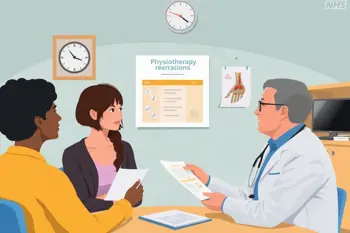
After submission, the service may assess the information before offering an appointment, directing the patient to digital self-management material, arranging an exercise class or recommending another clinical pathway. NHS physiotherapy can include a senior physiotherapist assessment, tailored exercises, education, pain-management advice and onward referral where necessary. The exact combination of care varies between local services and individual conditions. 1 3
Understand arrangements across the UK
Scotland, Wales and Northern Ireland operate through their own NHS structures, so the English self-referral process should not be assumed to apply elsewhere. NHS inform directs people in Scotland to local health-board services, and boards such as NHS Fife and NHS Ayrshire and Arran publish their own physiotherapy information and referral guidance. In Wales, local health-board arrangements determine how physiotherapy is accessed, while NHS Wales and NHS 111 Wales can help identify the appropriate route. 3 8 9 4
In Northern Ireland, physiotherapy is commonly discussed with a GP or another relevant healthcare professional, although individual services may set different referral procedures. Patients should therefore check the local health service instructions rather than rely on a form intended for another nation. This regional variation is a central practical limitation when attempting to book an NHS physiotherapy session. 5
Know when physiotherapy is not the first step
Routine musculoskeletal problems are commonly handled through physiotherapy pathways, but severe or significantly worsening pain warrants clinical advice rather than simply waiting for a routine appointment. A GP may be more appropriate when symptoms are complex, persistent or associated with wider health concerns. NHS 111 can provide guidance when it is unclear which service to use, while life-threatening symptoms require emergency help through 999 or an accident and emergency department. 1 5
- Seek urgent advice if the condition is severe or deteriorating.
- Use the local NHS pathway for routine back, neck, joint, strain or sprain concerns.
- Do not treat a physiotherapy referral as a substitute for emergency assessment.
Expect local variation and administrative delays
NHS physiotherapy is generally provided through NHS services without a patient treatment charge, whereas private physiotherapists operate separately and charge session fees. NHS departments may offer outpatient appointments, group exercise, home-based digital tools or tailored exercise plans, but the number and format of sessions are determined by clinical need and local capacity. Appointment locations can include hospitals, community clinics and GP surgeries. 1 3 10
The main friction points are differing eligibility rules, referral requirements, waiting arrangements, limited appointment locations and the need to respond to correspondence from the receiving service. A self-referral option may simplify the first administrative step, but it does not guarantee a particular appointment date or treatment format. Checking the local NHS provider’s instructions is therefore essential before submitting personal and clinical information. 6 7
Sources
- NHS, How to access NHS physiotherapy: https://www.nhs.uk/nhs-services/physiotherapy/how-to-access-nhs-physiotherapy/
- Chartered Society of Physiotherapy, Physiotherapy: https://www.csp.org.uk/public-patient/physiotherapy
- NHS inform, Physiotherapy: https://www.nhsinform.scot/tests-and-treatments/physiotherapy/
- NHS Wales, Physiotherapy: https://www.nhs.wales/health-and-wellbeing/nhs-services-and-teams/physiotherapy/
- nidirect, Physiotherapy: https://www.nidirect.gov.uk/articles/physiotherapy
- University Hospitals Sussex NHS Foundation Trust, Physiotherapy self-referral: https://www.uhsussex.nhs.uk/resources/physiotherapy-self-referral/
- Gloucestershire Hospitals NHS Foundation Trust, Physiotherapy self-referral: https://www.gloshospitals.nhs.uk/your-visit/patient-information-leaflets/physiotherapy-self-referral/
- NHS Fife, Physiotherapy: https://www.nhsfife.org/services/all-services/physiotherapy/
- NHS Ayrshire & Arran, Physiotherapy: https://www.nhsaaa.net/services/physiotherapy/
- Patient.info, Physiotherapy: https://patient.info/treatment-medication/physiotherapy