A guide to inspecting used chassis cab trucks from public-sector fleet auctions: A field checklist for UK buyers
Key facts
- UK inspection guidance recommends verifying the V5C, VIN, service history, MOT record, brake tests and repair evidence before bidding.1
- A low odometer reading can conceal heavy use when a chassis cab has spent long periods idling or operating auxiliary equipment.
- Structural rust, repeated welds, cracked mounts and sagging suspension can indicate overloading or previous impact damage.2
- A paid pre-purchase inspection for a used recovery truck is commonly reported at about £200–£400, while immediate rectification may run to £1,500–£3,000.3
A chassis cab combines a manufacturer-supplied cab, engine and frame rails with an open rear platform intended for a body such as a tipper, dropside, box body, recovery bed or utility installation. Public-sector fleet auctions can include vehicles formerly used by councils, emergency services and infrastructure departments, but duty cycles vary widely. A systematic inspection should therefore examine the vehicle’s structure, mechanical condition, records, legal status and suitability for the intended body before any bidding decision.
Start with the chassis cab’s intended job
The basic chassis cab configuration is only the starting point. A dropside may have carried materials, a tipper may have endured repeated loading cycles, and a utility body may have accumulated long engine hours while stationary. A vehicle that appears lightly used on the road can still have substantial wear from hydraulic pumps, auxiliary equipment, repeated short journeys and constant stop-start operation.
Gross vehicle weight determines the legal and practical envelope. A prospective operator should compare the plated maximum weight with the planned body, tools, crew and payload, allowing for the body’s own mass. Published UK recovery-truck guidance illustrates the importance of this distinction: a 3.5-tonne vehicle may carry roughly 1,200–1,400kg on its bed, while a 7.5-tonne slidebed belongs to a different operating category.3 The same principle applies to any chassis cab conversion.
Verify records before inspecting the metal
Auction conditions differ from a conventional private sale because the vehicle is commonly sold on a defined inspection basis, with limited opportunity to correct defects or obtain assurances after the sale. The first check is the identity trail. Match the registration, VIN, chassis plate and V5C details, then examine service invoices, maintenance schedules, brake-test records, tachograph calibration where relevant, and evidence of major repairs.
MOT history is a useful baseline rather than a mechanical guarantee. Look for recurring advisories involving brakes, steering, suspension, corrosion, tyres or lighting, and compare recorded mileage for a logical progression. A professional used-truck checklist identifies the V5C, VIN, full service history, MOT history, brake records, tachograph information and major-repair evidence as core documents; missing paperwork increases uncertainty.1 Fleet records can be detailed because scheduled maintenance is often recorded, but a complete file does not prove that every component is currently sound.
Inspect frame rails, mounts and bodywork
Frame integrity is the most consequential structural issue. Examine both sides of the rails, crossmembers, spring hangers, cab mounts, body brackets and areas around tow equipment. Surface dirt can hide corrosion, so the inspection should include accessible inner faces and the underside. Uneven paint, fresh underseal or localised coating may indicate an earlier repair rather than routine preservation.
Previous welding is not automatically disqualifying, but its location, quality and documentation matter. Cracked or poorly finished welds, distortion, drilled or elongated mounting holes and evidence of impact should prompt an independent structural assessment. Guidance for used trucks specifically flags structural corrosion around chassis rails and mounting points, along with repeated repair welds, sagging and cracked mounts as possible indicators of overloading or severe use.2 Any body that is near the end of its service life should be valued as a potential replacement project, not treated as an asset at no cost.
Assess engine, transmission and idle hours
Inspect the engine cold where possible. Check oil level and condition, coolant level, leaks, belt condition, hoses and signs of contamination. On startup, persistent blue smoke can indicate oil burning, while continuing black smoke may point to fuelling or air-management problems. Brief white vapour in cold conditions can be normal, but persistent smoke requires diagnosis rather than assumption.
The road test should include cold starting, low-speed manoeuvring, acceleration under load, braking and operation at normal road speed. The engine should pull cleanly without abnormal knocking, whining or grinding. Transmission engagement should be smooth, with no slipping, hesitation or grinding; these are established inspection points in commercial-vehicle guidance.2 Engine hours are especially important for council, utility and emergency vehicles because extensive stationary operation can leave substantial wear that the odometer does not show.
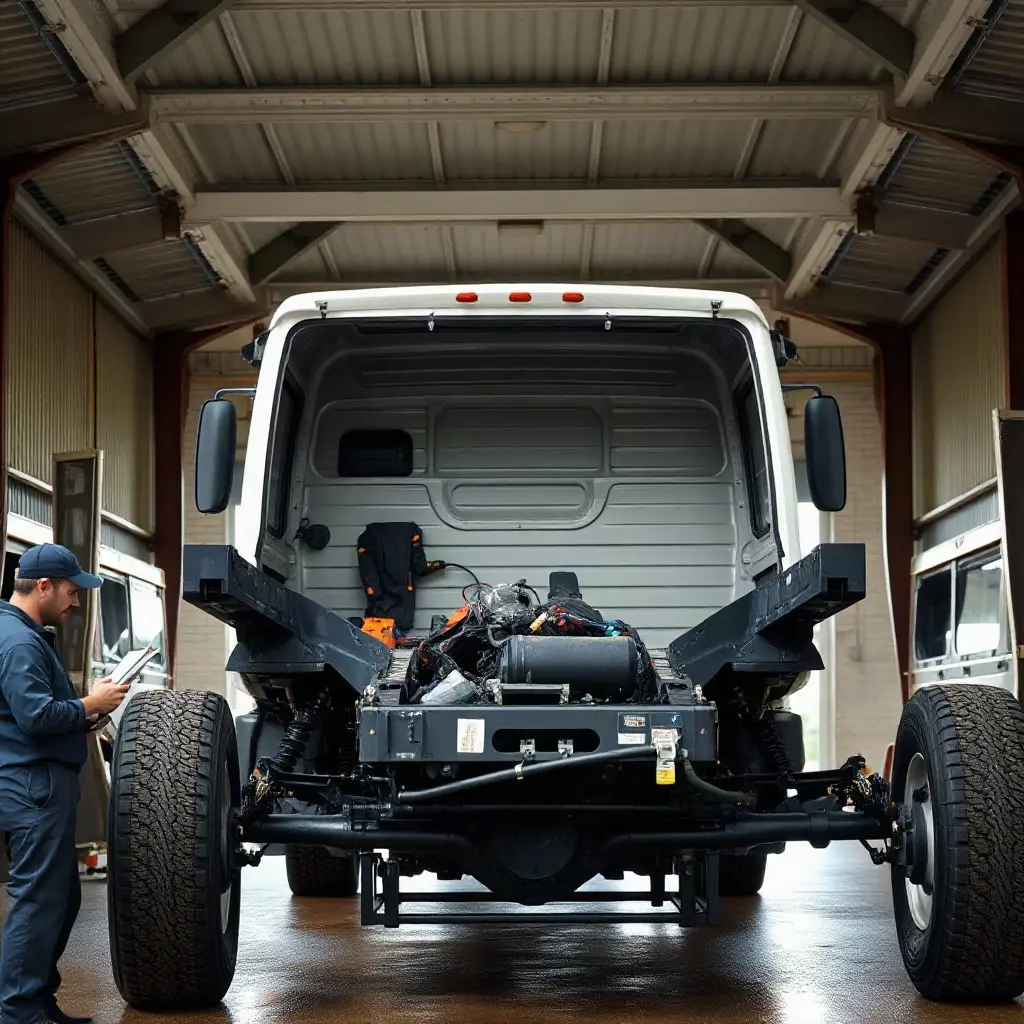
Check suspension, brakes, tyres and electrics
Uneven ride height, leaking dampers, damaged leaf springs, worn bushes and cracked suspension mounts deserve close attention. Compare tyre wear across each axle and between paired tyres, looking for scalloping, shoulder wear or mismatched patterns. Brakes should be checked for uneven wear, damaged hoses, air-system leaks where fitted, warning lights and abnormal pull during a controlled test.
The cab inspection should cover seat mounts, pedals, steering play, heater operation, windscreen condition, mirrors, wipers, warning lamps and every switch. Work through all lighting, warning beacons, reversing alarms, auxiliary sockets and body controls. Fleet trucks can show extensive cab wear from multiple drivers even when the powertrain is acceptable. Electrical faults may also be associated with removed equipment, altered wiring or corrosion at body connections, so additions should be traced rather than judged only by appearance.
Look for evidence of overloading and hard service
Public-sector use is not uniform. Refuse, highways, parks, grounds maintenance, utilities and emergency response impose different stresses. Ask what the vehicle did, where it operated and whether it regularly carried tools, aggregates, water or specialist equipment. Repeated short trips increase cold-start and braking exposure, while urban work can produce clutch, steering, suspension and body damage despite modest mileage.
Compare the current body and equipment with the plated weights and the documented operating role. Dents beneath the body, distorted rails, stretched fasteners, cracked steps, damaged tailboards and hydraulic leaks can reveal loading or impact history. A used-truck inspection guide warns that uneven ride height, leaking shock absorbers, worn leaf springs, sagging components and repeated welds may indicate a vehicle worked beyond its rated capacity.2 These findings should be treated as safety and compliance issues, not merely cosmetic defects.
Budget the conversion and ownership risk
The purchase decision should include the cost of making the chassis cab suitable for its next role. Possible work includes removing old bodywork, repairing subframes, replacing hydraulic hoses, renewing lights and wiring, adapting PTO equipment, fitting a new tipper or dropside, and bringing the vehicle into the required weight and emissions category. Body condition can matter more than cab appearance because replacement or refurbishment may dominate the first year’s expenditure.
Independent inspection is a separate cost but provides useful risk control. A UK recovery-truck guide places a paid pre-purchase inspection at approximately £200–£400 and suggests allowing £1,500–£3,000 for immediate rectification on a used vehicle, including hydraulic, winch and brake work.3 Those figures are a recovery-truck reference, not a universal chassis-cab estimate. The final assessment should also account for MOT preparation, tyres, taxation, compliance inspections, downtime, body certification and ongoing preventive maintenance.
Compare configurations rather than relying on reputation
There is no universally reliable chassis-cab model for every public-sector task. The relevant comparison is between weight class, wheelbase, axle layout, engine output, gearbox, emissions equipment, cab size, payload after body installation and the availability of compatible parts and technicians. A smaller configuration may suit urban access, while a heavier frame may be necessary for a tipper or specialist body, but higher capacity does not remove the need to verify actual condition.
The final decision should combine the physical inspection with records and a written repair allowance. Reject or pause a vehicle when the VIN cannot be reconciled, structural corrosion is advanced, frame repairs are unexplained, braking defects are unresolved, the body exceeds the planned weight envelope or the seller cannot document major work. Public-sector maintenance records can be valuable evidence of scheduled care, yet they describe past servicing rather than guarantee future reliability. The safest conclusion comes from matching verified history, measured condition and intended use.
Sources
- Used Truck Inspection Checklist | UK Fleet Buyer Guide: https://dawsondirect.co.uk/used-truck-inspection-checklist-how-uk-fleet-buyers-can-avoid-costly-mistakes/
- How to Inspect a Used Truck Before Buying: A Buyer's Checklist - Sotrex Limited: https://sotrex.com/how-to-inspect-a-used-truck-before-buying-a-buyers-checklist/
- Buying a Used Recovery Truck: What to Check First — mcgeminirecovery.co.uk: https://mcgeminirecovery.co.uk/used-recovery-vehicle-buying