Full mouth dental implants: a guide to the process for UK patients: clinical and cost context
For UK patients researching full mouth dental implants, the central questions are how the process works, what treatment may involve, how long it takes and what costs may arise. Current UK guidance describes treatment as a personalised full-arch restoration rather than a single standard procedure, with clinical assessment determining the appropriate approach. 1
What full mouth dental implants mean
Full mouth dental implants replace all or most teeth in one or both dental arches using implants placed into the jawbone as foundations. The treatment does not normally require one implant for every missing tooth. Instead, a planned number of titanium implants may support a fixed bridge or an implant-retained denture. 2
A fixed full-arch bridge is secured to the implants and is not designed for the patient to remove. An implant-retained denture remains removable but is anchored to implants for greater stability than a conventional denture. Common fixed approaches include All-on-4 and All-on-6, referring broadly to four or six implants supporting one arch. 1
Assessment, scans and suitability
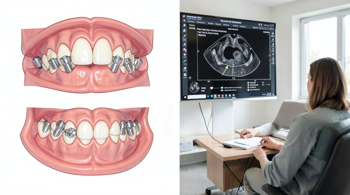
The process begins with a consultation covering the condition of remaining teeth, gums, bite, medical history and treatment objectives. Three-dimensional CBCT imaging is used to assess jawbone anatomy and density, while the results help determine implant positions and whether preliminary procedures may be required. 3
Suitability is not determined by tooth loss alone. Bone volume, gum health, bite forces and general clinical factors influence the plan. Patients with insufficient bone may require grafting, although angled implants in some All-on-4 plans can help avoid more extensive grafting in suitable anatomical circumstances. A second clinical opinion may be appropriate where only one approach is presented regardless of anatomy. 4
How the treatment process unfolds
After assessment and consent, the surgical stage places the implants into the jawbone. Existing teeth may need extraction where they are unsuitable for preservation. A temporary bridge or denture may be used during healing, depending on implant stability and the planned protocol. Immediate fixed teeth can be possible in selected cases, but this is not an appropriate expectation for every patient. 5
The implants then undergo osseointegration, the period in which they fuse with surrounding bone. Treatment information supplied for UK patients commonly places the overall journey between four and twelve months, although uncomplicated cases and immediate-loading protocols can follow shorter schedules. The definitive bridge is fitted only after clinical checks confirm that the foundations are sufficiently stable. 1
Indicative UK costs and treatment times
Private pricing varies according to the number of implants, the material used for the bridge, surgical complexity, extractions, grafting and the experience of the clinical team. Published UK estimates place complete treatment broadly between £15,000 and £50,000, while a fixed full arch is commonly reported at approximately £12,000 to £25,000 per jaw. These are market ranges, not quotations for an individual case. 1
| Approach | Indicative UK context | General distinction |
|---|---|---|
| Implant-retained overdentures | About £8,000 to £16,000 for both arches | Removable teeth anchored to implants |
| All-on-4 | About £18,000 to £28,000 for both arches | Four implants per arch supporting a fixed bridge |
| All-on-6 | About £22,000 to £36,000 for both arches | Six implants per arch, where anatomy and bite support it |
Risks, regulation and informed consent
Implant treatment involves surgery and therefore carries potential clinical risks, including complications associated with healing, insufficient bone, gum disease and excessive bite forces. Long-term outcomes depend on hygiene, regular professional review and the condition of the surrounding tissues. Reported implant success rates above 95 percent apply to selected clinical circumstances and should not be treated as a guarantee for an individual patient. 9
UK patients should receive an explanation of alternatives, foreseeable risks, expected stages, costs and aftercare before consenting. Dentists must be registered with the General Dental Council, and private dental facilities may also fall within Care Quality Commission oversight depending on the services provided and the jurisdiction involved. Checking professional registration and requesting a written plan are practical safeguards. 7 8
Recovery, maintenance and NHS position
Following surgery, patients may be advised to follow a soft-food diet while the implants and surrounding tissues heal. Cleaning requirements are different from those for natural teeth because plaque can collect around the bridge and implant connections. Regular examinations, professional cleaning and careful daily hygiene are central to protecting the restoration. 10
Full mouth implant treatment is generally private elective care in the UK. NHS funding does not normally cover it, except in narrow medical circumstances. Patients considering finance should examine the total treatment cost, what is included, replacement terms, maintenance charges and the consequences if an implant or prosthetic component requires repair. Long-term care remains necessary even after the final teeth are fitted. 1 3
Sources
- Dental Implant Quote, “Dental Implants for Full Mouth: Everything UK Patients Ask”
- Smile Dentist London, “Full Mouth Dental Implants Explained”
- British Dental Association and NHS England information referenced in the research data
- UK Dental Guide, “Full Arch Dental Implants UK 2026”
- Dental Wellness London, “Full Mouth Dental Implants: Procedure, Treatment Options and Cost”
- Bupa UK, dental implant treatment information
- General Dental Council, professional registration information
- Care Quality Commission, healthcare standards information
- National Institutes of Health, peer-reviewed evidence on dental implant outcomes
- Oral Health Foundation, dental implant aftercare information