Natural Circulation Improvement Methods for Performance: An Engineering Analysis
Fundamentals of Buoyancy-Driven Flow and Why Improvement Matters
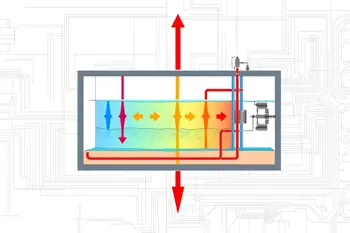
Natural Circulation Loops (NCLs) operate without mechanical pumps by exploiting density differences between heated and cooled fluid regions to generate buoyancy-driven flow. The flow dynamics arise from the interaction between buoyancy forces in heated sections and frictional resistance in cooled portions, a mechanism documented in foundational thermofluidic research spanning decades. 1 Applications extend across nuclear reactor passive cooling, solar water heaters, geothermal energy extraction, electronics cooling, and space technologies, making performance improvement a cross-sector engineering priority. 2
Despite conceptual simplicity, NCLs exhibit complex thermofluidic behavior under transient or high-power conditions, including flow reversals, oscillations, and stability thresholds that critically affect reliability. 2 Following the 2011 Fukushima Daiichi incident, ongoing validation of reactor safety technologies incorporating passive cooling systems as backup mechanisms during transient conditions has become essential, intensifying research interest in quantifiable performance improvement pathways. 1 Understanding how to systematically raise mass flow rates, reduce instability, and extend stable operating windows is therefore both a scientific and safety imperative.
Geometric and Loop Configuration Strategies
Loop geometry is one of the most direct levers for improving natural circulation performance. Experimental research using the FASSIP-04 Ver.0 rectangular loop facility, with an inner diameter of 26.64 mm, a loop height of 2,280 mm, and a width of 780 mm, demonstrated that inclination angle significantly influences mass flow rate and heat removal capability. The highest values were recorded at a 90-degree inclination angle and a water heating tank temperature of 90 degrees Celsius, yielding a mass flow rate of 0.0241 kg/s and heat removal rates of qH = 0.791 kW and qC = 0.489 kW. 3 These results confirm that vertical orientation maximizes the gravitational component of the buoyancy driving head.
Hydraulic diameter selection also governs system behavior. Studies on miniaturized loops with a hydraulic diameter of 3 mm show that surface characteristics have a proportionally greater influence on flow than in larger channels, because flow rates within NCLs are inherently lower than in forced convection systems. 4 Helical and serpentine pipe arrangements improve natural circulation by enhancing fluid mixing and reducing stagnant zones relative to straight configurations, a finding supported by general thermal-hydraulic design literature. Minimizing bends, valves, and other flow restrictions along the circuit path directly reduces frictional resistance and sustains higher buoyancy-driven velocities.
Heating Power and Temperature Gradient Optimization
Increasing applied heating power is among the most experimentally well-characterized methods for enhancing natural circulation. An open natural circulation loop study conducted at heating powers of 5,000 W, 10,000 W, 15,000 W, and 20,000 W produced corresponding flow rates of 2.69 L/min, 3.58 L/min, 4.19 L/min, and 4.66 L/min, respectively. Temperature differences between the water heating tank inlet and outlet were 22.48 degrees Celsius, 33.83 degrees Celsius, 42.7 degrees Celsius, and 51.85 degrees Celsius across those power levels, confirming that larger temperature gradients amplify buoyancy forces and consequently raise flow velocity. 5
In turbulent large-scale single-phase NCL experiments conducted using the FASSIP-02 Ver 02 facility with heat source temperatures between 50 degrees Celsius and 80 degrees Celsius, the system achieved a maximum flow rate of 28.5 L/min at a heat source temperature of 80 degrees Celsius. Reynolds numbers ranged from 13,521 to 33,850 and Grashof numbers from 2.997 x 10 to the power of 12 to 1.739 x 10 to the power of 13, confirming fully turbulent operation above a Rayleigh number threshold of 10 to the power of 8. A validated correlation between Re and Gr/NG was established, with C = 0.00735 and R-squared = 0.96, providing a quantitative predictive model for buoyancy-flow interaction. 6
Working Fluid Selection and Nanofluid Enhancements
The choice of working fluid exerts a direct influence on density difference, specific heat capacity, and viscosity, all of which govern circulation intensity and heat transfer efficiency. Research published in Progress in Nuclear Energy identifies working fluid properties alongside geometry parameters as co-equal determinants of stability and mass flow rates in rectangular single-phase NCLs. 1 Supercritical carbon dioxide has emerged as a subject of dedicated investigation for dual natural circulation systems, with numerical studies addressing thermohydraulic performance improvements attributable to the fluid's sharp property variations near the critical point. 7
Nanofluid additions represent a more recent enhancement pathway. Studies evaluating 0.01 and 0.02 volume percent aluminum oxide and silicon dioxide nanofluids in natural circulation mini-loops with a hydraulic diameter of 3 mm found that dilute metal oxide nanofluids altered convective heat transfer characteristics relative to deionized water baselines. Surface modifications at the heater section using vacuum ultraviolet-treated polydimethylsiloxane coating reduced the contact angle from 86.2 degrees to 2.7 degrees, which further influenced the heat transfer coefficient under power inputs of 10, 15, and 20 W and heat sink temperatures of 20 and 30 degrees Celsius. 4 These findings indicate that both fluid thermophysical properties and heater-surface wettability jointly determine NCL thermal performance.
Advanced Control Systems: Model Predictive and Optimal Control
Passive operation of NCLs does not preclude the application of control strategies that optimize stability and efficiency under variable conditions. Research from the University of Alberta investigated thermo-syphoning in a rectangular closed-loop system using a Linear Quadratic Regulator and a Model Predictive Control framework. The results demonstrated that MPC with active constraints improves system stability and reduces initial energy requirements by nearly one-third compared to unconstrained MPC and LQR configurations. 8 MPC's predictive capability and adaptability to physical constraints were identified as advantages for real-time industrial applications in process engineering, oil and gas, and geothermal sectors.
In the context of two-phase systems, the FASSIP-06 facility experiments showed that operating at 4,000 W heater power and 7.5 LPM coolant flow achieved the fastest transient response, reaching steady state at 4,863 seconds with the highest outlet temperature and flow rate, but also exhibited the strongest flow oscillations. By contrast, 3,000 W and 5 LPM produced the most stable operation with longer stabilization time and reduced oscillation amplitude, illustrating the inherent trade-off between circulation intensity and flow stability. 9 Increasing heater power from 3,000 W to 4,000 W enhanced steady-state circulation by up to 33 percent in volumetric flow rate, quantifying the sensitivity of two-phase NCLs to thermal input. 9
Computational Modeling and Simulation Tools for Design Optimization
CFD simulation and system-code modeling are now standard tools for predicting natural circulation behavior before physical prototyping. ANSYS Fluent simulations of the FASSIP-06 Ver.03 loop applied a three-dimensional model with the RNG k-epsilon turbulence model and scalable wall functions, with heater power variations spanning 750 W to 1,050 W, to characterize single-phase natural circulation thermal and flow characteristics. 10 RELAP5-3D code has been validated against experimental data from single-phase NCL facilities, with the University of Idaho study providing benchmark datasets that quantify the gap between simulation predictions and measured thermal-hydraulic behavior. 11
For multi-channel configurations relevant to high-temperature gas reactors, RELAP5-3D and CFD models must accurately predict both steady-state heat removal capacity and flow stability margins to prevent flow reversal or localized overheating during accidents such as the Pressurized Loss of Forced Cooling transient. 12 At the reactor safety scale, the VPEX experimental facility for passive ex-vessel core catcher cooling recorded satisfactory cooling performance at an average heat flux of 232 kW per square meter, which is 1.75 times higher than the predicted heat flux value, with the Wallis model providing the most accurate void fraction and natural circulation mass flow rate predictions. 13
Stability Risks, Constraints, and Design Trade-Offs
Improving natural circulation performance is not without inherent trade-offs and risks that engineers must account for systematically. Higher heating power and flow rates increase the likelihood of density-wave oscillations, geysering, and flow reversal events that can undermine passive cooling reliability. Flow visualization in the FASSIP-06 system at 3,000 W and 3 LPM documented transitions from bubbly to slug, churn, and annular flow regimes between 85 degrees Celsius and the saturation temperature, marking boundaries of stable and unstable operation. 9 Identifying these stability windows is a prerequisite for safe design.
Subcooling level and inlet pressure also constrain performance. In core catcher cooling experiments, lower inlet pressures and less subcooling enhanced natural circulation mass flow rates and void fractions, but variations in inlet pressure, subcooling, or heat flux had minimal impacts on surface heat transfer characteristics such as boiling curves or heat transfer coefficients, underscoring that not all parameter changes translate into proportional performance gains. 13 Large-scale facilities consistently exhibit lower heat transfer coefficient values compared to laboratory-scale setups, a scaling effect that must be incorporated into design assumptions. From a regulatory standpoint, any NCL design modification in nuclear applications requires independent verification and validation against established safety codes, experimental benchmarks, and applicable national or international standards before deployment in safety-critical systems.
Sources
- ScienceDirect - Progress in Nuclear Energy, Volume 191, 2026: Design of rectangular single-phase natural circulation loop based on working fluid and geometry parameters (Waluyo et al., 2025)
- ScienceDirect - Applied Thermal Engineering, October 2025: Overview of fundamental aspects of natural circulation loops (Hashemi-Tilehnoee et al.)
- Atom Indonesia, 2025: The Effect of Loop Inclination on Natural Circulation Mass Flow Rate and Heat Removal Inside Rectangular Passive Cooling Loop (Budiyanto et al.)
- Heat Transfer, 2025: Estimation of Convective Heat Transfer in Dilute Metal Oxide Nanofluids in a Natural Circulation Mini Loop With a VUV Surface Tuned Heater Section (Mohan et al.)
- Journal of Physics Conference Series, 2026: The Effect of Heating Power Variation on Flow Characteristics in an Open Natural Circulation Loop (Ismarwanti et al.)
- Journal of Physics Conference Series, 2026: Investigation of Thermohydraulic Performance in a Turbulent, Large-Scale Single-Phase Natural Circulation Loop (Gunawan et al.)
- Results in Engineering, 2025: Numerical investigation of thermohydraulic performance in supercritical CO2-based dual natural circulation systems (Tamilarasan and Kanna)
- Sustainability, 2025: Optimal and Model Predictive Control of Single Phase Natural Circulation in a Rectangular Closed Loop (Hassan et al., University of Alberta)
- IOP Conference Series: Earth and Environmental Science, 2026: Preliminary investigation of performance and instability in a two-phase natural circulation passive cooling system (Prayogo et al.)
- Proceeding of International Conference on Digital, Social, and Science, 2025: Simulation on Thermal and Flow Characteristics Investigation of Natural Circulation Under Different Heating Powers using FASSIP-06 Ver.03 Loop (Kharisma et al.)
- Journal of Nuclear Engineering, 2025: Preliminary Experimental Validation of Single-Phase Natural Circulation Loop Based on RELAP5-3D Code: Part I (Abdellatif et al., University of Idaho)
- Nuclear Engineering and Design, July 2026: Natural circulation in a Multi-Channel flow loop: effects of heating configuration and working fluid (Tursynkhan et al.)
- Nuclear Engineering and Technology, 2025: Experimental study on natural circulation cooling system for core catcher with downward-facing heating channel (Jeong et al.)