How to prepare your home for a rescue dog: a shelter adoption checklist
Understanding Rescue Dog Adjustment: The 3-3-3 Framework
Before any physical preparation begins, adopters benefit most from understanding what a rescue dog actually experiences during transition. Shelters, trainers, and behaviorists widely reference the 3-3-3 adjustment framework as a realistic guide: the first 3 days are characterized by decompression, during which a dog may hide, refuse food, or avoid eye contact; the first 3 weeks involve beginning to learn household routines; and the first 3 months mark the period during which genuine trust and security are established. 1 Every dog moves through this differently, and the framework is a general pattern rather than a fixed promise.
The San Francisco SPCA notes that during the initial 3 days, behaviors such as hiding, reduced appetite, and reluctance to explore are normal stress responses rather than signs of a permanent personality trait. 2 Certified trainer Amanda Farah of Best Friends Animal Society states that it is significantly less stressful for the dog when they arrive to a space that has been prepped to meet their needs and to a family that knows what to expect in those first few weeks. 3 Most rescue dogs settle in successfully, with 94% rated as having excellent or good behavior six months post-adoption. 1
Household Readiness: Agreements Before the Dog Arrives
The American Animal Hospital Association (AAHA) recommends holding a household meeting before the dog arrives to establish consistent routines and agree on rules covering furniture access, sleeping areas, safe spaces, and realistic expectations about the adjustment period. 4 Determining in advance who is responsible for feeding, bathroom breaks, training, and playtime prevents the kind of inconsistency that slows a rescue dog's settling process. Rescue dogs thrive on predictability, and contradictory rules from different household members can delay behavioral stabilization by weeks.
Lifestyle assessment is equally important before committing. Dogs need a minimum floor of 1 to 2 hours of structured daily time covering exercise, feeding, training, and attention, with high-energy breeds requiring considerably more. 5 Routine dog ownership costs between $100 and $400 per month for most owners, covering food, preventative veterinary care, and basic supplies, with the first year typically running higher due to setup costs and an initial vet visit. 5 Budget planning before adoption prevents the financial surprises that contribute to early returns.
Dog-Proofing Your Home: Room-by-Room Safety Measures
A thorough safety sweep of accessible areas is a non-negotiable step before any rescue dog arrives. Common hazards that must be addressed include toxic foods such as chocolate, grapes, onions, and xylitol (frequently found in sugar-free products), toxic houseplants including lilies, philodendrons, sago palms, and aloe vera, unsecured trash cans, exposed electrical cords, cleaning products, medications, and small objects that can be swallowed. 6 Enzyme-based cleaners should also be stocked in advance, as many rescue dogs have accidents during the adjustment period even if previously house-trained.
Outdoor spaces require equal attention. Fencing should be inspected for gaps, low spots, or loose boards, as even a calm rescue dog may attempt to bolt during the disorienting first days. 7 Many organizations recommend fencing at a minimum of 1.5 metres high, with all ground-level gaps checked, because anxious dogs can squeeze through surprisingly small spaces. Safety gates inside the home can restrict access to certain rooms while the dog is still learning household boundaries, providing a controlled environment for gradual exploration rather than overwhelming freedom on day one.
Essential Supplies Checklist Before Adoption Day
Having all core supplies in place before the dog arrives removes unnecessary stress from the first hours at home. Shelters often advise asking what food the dog has been eating and continuing that diet initially, since sudden dietary changes can cause digestive upset during an already stressful transition. 6 A front-clip harness is specifically recommended for rescue dogs who may pull or have tracheal sensitivities, and a fixed-length leash of 1.5 to 2 metres is preferable over retractable leashes during the adjustment period as it provides better control. 8
The following table summarizes the core supplies that shelter and veterinary guidance consistently identifies as necessary before bringing a rescue dog home.
| Category | Item | Key Consideration |
|---|---|---|
| Containment | Collar, leash, ID tag | ID tag with current contact information is essential before the first walk |
| Containment | Front-clip harness | Reduces pulling without harsh corrections; recommended for anxious dogs |
| Comfort | Crate or dog bed | Crate should be large enough for the dog to stand and turn around |
| Feeding | Food and water bowls | Heavy ceramic or stainless steel prevents tipping |
| Feeding | Familiar food from shelter | Dietary continuity prevents digestive stress during transition |
| Safety | Enzyme-based cleaner | Eliminates odor traces that encourage repeat accidents |
| Enrichment | Chew toys and puzzle toys | Reduces stress-driven destructive behavior during decompression |
| Grooming | Brushes, nail clippers, dog-safe shampoo | Coat-type appropriate tools should be sourced before arrival |
Setting Up a Safe Space and Establishing Routine
Every rescue dog needs a designated safe zone, a low-traffic area such as a corner of a bedroom or a quiet room equipped with a crate or bed, fresh water, and simple toys. 7 If the rescue organization can provide a familiar blanket from the shelter, the familiar scent can meaningfully ease the transition. The safe space should not be overly stimulating; the goal is a calm retreat the dog can access voluntarily when overwhelmed, rather than a confined punishment area. Resist the urge to fill the first days with excitement, visitors, dog parks, or busy outings, as lower stimulation during decompression consistently supports faster settling. 9
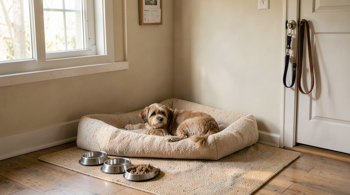
Establishing a consistent routine for feeding, walking, and toilet breaks from day one provides the predictability rescue dogs depend on for emotional regulation. Battersea Dogs and Cats Home specifically advises gradual introduction to alone time, starting with just a few minutes, to prevent separation anxiety from taking hold in the first weeks. 10 Puppy pads placed strategically near doors support house-training during the early period when the dog is still learning where outdoor access is and what the household schedule looks like.
Veterinary Care, Microchipping, and Documentation
Scheduling a veterinary visit within 7 days of adoption is a standard recommendation from both the ASPCA and ASPCApro guidance. 11 This visit establishes a baseline health record, allows the vet to review vaccination status, confirm or update microchip registration, discuss parasite prevention, and address any behavioral concerns based on the dog's age and known history. AAHA-accredited practices follow Canine Life Stage Guidelines to develop individualized preventive health plans tailored to the specific dog's needs. 4
Microchip information should be verified and updated before or immediately after adoption. According to adoption documentation research, microchipped dogs have a 93% return rate if lost, but only when the registration information is current. 12 Adopters should request copies of all medical records, vaccination history, and any behavioral assessments completed by the shelter at the time of adoption handover, as this documentation saves the vet time and prevents redundant testing. Dog training is an unregulated field, so when seeking behavioral support, AAHA and certified trainers recommend looking specifically for credentials from the CCPDT, PPG, or IAABC certification bodies to ensure the methodology used is evidence-based. 4
Common Risks, Challenges, and Realistic Expectations
Approximately 1 in 10 adopted pets is returned to the shelter within six months, and the cause is almost always a preparation gap rather than a fundamental incompatibility with the dog. 13 Rescue dogs often arrive with unknown histories; some may have experienced abandonment, multiple home transitions, or the psychological stress of a loud shelter environment. Certified trainer Maddie Messina of Paws for Thought Training notes that most shelter dogs have experienced some level of trauma, not necessarily from direct human aggression but potentially from living in a loud, stressful environment. 14 This context shapes how dogs respond in the first days and why low-stimulation environments and patient routines matter so much.
New adopters should specifically avoid the common mistake of interpreting a withdrawn or quiet dog as a permanent behavioral trait, or responding by flooding the dog with social interactions in an attempt to accelerate bonding. What appears as sadness in the first days is more accurately described as a stress response while the dog's nervous system recalibrates to entirely new surroundings, new smells, new people, and new rules. 15 Many shelters offer continued post-adoption support and can provide referrals to trainers, behaviorists, and other community resources, making them a valuable ongoing contact rather than a one-time transaction point. 4
Sources
- Spot Pet Insurance - Adopting a Rescue Dog: What to Expect and How to Prepare in 2026 (spotpet.com)
- San Francisco SPCA - The 3-3-3 Guideline (sfspca.org)
- The Spruce Pets - The Dog Adoption Issue (thesprucepets.com)
- American Animal Hospital Association - New Dog Checklist: Your Step-by-Step Guide to a Successful Start (aaha.org)
- Dogs Portal - Adopting a Dog: Readiness Guide and Prep Checklist (dogs-portal.com)
- Wagglor - How to Prepare Your Home for a Rescue Dog: A Complete Checklist (wagglor.com)
- Amazing Dogs Rescue - How to Prepare Your Home for a Rescue Dog (amazingdogsrescue.org)
- Pet Rescue NZ - Pet Adoption Checklist and Home Preparation (petrescue.org.nz)
- One Frazzled Dog - How to Prepare Your Home for a Rescue Dog: UK Checklist (onefrazzleddog.com)
- Battersea Dogs and Cats Home - Rehoming Guide: Adopt a Rescue Dog (battersea.org.uk)
- Petmeetly - Dog Adopter's Checklist: Before, During and After (petmeetly.com)
- The Fuss Wire - The Same-Day Dog Adoption Checklist (thefusswire.com)
- One Health Globe - Pet Adoption Starter Guide and Checklist 2026 (onehealthglobe.com)
- The Farmer's Dog - Here Are the Best Ways to Help Your New Shelter Dog Feel at Home (thefarmersdog.com)
- Pups N Paws Dog Training - Rescue Dog Checklist: What You Actually Need (pupsnpawsdogtraining.com)