New Spring gentle mobility sessions for active older adults: Evidence, formats, and safety considerations
New spring gentle mobility sessions for active older adults commonly combine controlled movement, balance practice, light strengthening, walking, and social connection. Recent community programmes describe formats ranging from Senior Tai Chi and chair-supported yoga to six-week balance and strength classes, reflecting a broader shift toward accessible activity that can be adapted to different abilities. 1
What gentle mobility sessions typically include
Gentle mobility is not limited to stretching. A well-structured session may include a warm-up, controlled joint movements, supported standing, balance drills, functional strength exercises, breathing, and a gradual cool-down. The Chartered Society of Physiotherapy advises keeping active through manageable movement that is adapted to individual ability and health needs, while guidance on arthritis supports regular, appropriately paced activity. 2
Spring programmes can therefore offer several levels of challenge rather than one fixed routine. Participants may remain seated for some exercises, use a chair or wall for support, or progress to standing, walking, and light resistance work when appropriate. Low-impact options such as walking, cycling, swimming, and tai chi can help maintain activity while reducing joint impact, although the suitable choice depends on personal health and tolerance. 3
How weekly activity guidance shapes programme design
UK guidance recommends that adults aged 65 and over accumulate at least 150 minutes of moderate-intensity activity each week, alongside muscle-strengthening activity on at least two days. Older adults are also advised to include activities that improve balance and coordination at least twice weekly. A gentle mobility class is one possible component of that broader pattern, not a substitute for all weekly movement. 4
Short bouts can be useful when continuous exercise is difficult. Age UK notes that activity can be accumulated in shorter periods and that regular movement supports physical and mental wellbeing in later life. A spring schedule might therefore divide a session into accessible blocks, such as mobility work, balance practice, walking, and light strengthening, with rest periods between activities. 5
- Mobility: controlled range-of-motion movements.
- Balance: supported weight shifting and coordination tasks.
- Strength: gradual exercises for functional movement.
- Walking: indoor or outdoor activity adjusted to conditions.
- Recovery: breathing, stretching, and a measured cool-down.
Balance and falls prevention
Balance work is a central distinction between a general stretching class and a falls-prevention programme. NICE guidance recommends strength and balance training as part of interventions intended to reduce falls risk, while the World Health Organization describes multicomponent activity for older adults as emphasising functional balance and strength. These principles support exercises that resemble daily tasks, including controlled standing, stepping, turning, and transferring weight. 6
Community examples show how this emphasis is applied. A seven-week Stepping On workshop reported by the Monroe Times combines balance and strength exercises with home-safety strategies and discussion of vision, medication, footwear, and environmental hazards. A separate Matter of Balance session in Martha’s Vineyard uses education, discussion, gentle exercise, and peer support to address both physical risk and fear of falling. 7
Examples of spring community formats
Several reported programmes illustrate the range of delivery models. Camden County described Senior Tai Chi as a gentle, low-impact activity intended to improve balance and flexibility. In Freeport, Better Balance & Strength for Older Adults was presented as a six-week class led by physical therapists, with participants of all fitness levels welcomed. These examples indicate that gentle mobility can be offered through either mindful movement or clinically guided exercise. 1
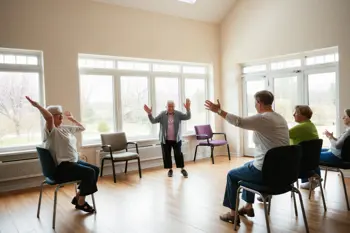
Chair-based formats provide another option for people who need additional stability. A reported restorative chair yoga session uses chairs for seated movements and supported standing or balancing exercises, with attention to posture, flexibility, mobility, controlled movement, breathing, and relaxation. A separate Chair Yoga Connections model includes companions or caregivers and places social interaction alongside physical activity, which may be relevant for adults who benefit from extra support. 8
Accessibility, weather, and social connection
Outdoor spring sessions can encourage walking and social participation, but organisers need alternatives for cold, wet, or uneven conditions. The Ramblers identifies walking as relevant to physical and mental wellbeing, while Sport England’s Active Lives research supports the development of inclusive opportunities for older adults. Practical accessibility includes sheltered or indoor space, clear demonstrations, seating, rest intervals, and routes that do not create avoidable trip hazards. 9
Social design can influence whether people continue attending. Royal Voluntary Service activity and companionship services reflect the role of connection in later-life wellbeing, and reported local programmes often combine exercise with a welcoming group environment. The Haworth gentle fitness initiative, for example, was developed to meet older adults physically, socially, and emotionally, while Chair Yoga Connections encourages participation with a friend, companion, or caregiver. 10
Safety, eligibility, and realistic expectations
Gentle exercise still requires screening and adaptation. People with significant health conditions, recent surgery, chest pain, unexplained dizziness, or new severe pain should seek appropriate clinical advice before increasing activity. The British Heart Foundation advises gradual progression, warm-up and cool-down periods, and medical advice when symptoms or health concerns make exercise uncertain. A class labelled gentle does not remove the need to monitor symptoms. 11
Eligibility rules vary by programme. Some sessions are designed for adults aged 50 and over, some welcome all fitness levels, and others are specifically structured for people with mobility challenges or caregivers. Participants should check whether the instructor has relevant training, whether seated and supported options are available, how emergencies are handled, and whether registration or advance assessment is required. The practical objective is consistent participation at an appropriate level, rather than maximising intensity in a single session.
Assessing a session before participation
A useful review of any spring mobility session considers its content, supervision, environment, and progression. Programmes focused only on stretching may not address the strength and balance elements associated with falls prevention. Conversely, a class that moves too quickly or provides no supported alternative may be unsuitable for participants with arthritis, reduced confidence, or fluctuating energy. Clear instruction and the ability to reduce range, pace, or resistance are important indicators of adaptability.
Reported community models range from weekly chair yoga and tai chi to structured six- and eight-week courses. Their schedules, locations, fees, registration requirements, and dates differ, and some published events have already passed or are tied to a particular locality. The most reliable expectation is therefore a flexible format built around mobility, balance, strength, recovery, and connection, with individual suitability confirmed before participation.
Sources
- Camden County, NJ: Senior Tai Chi
- Chartered Society of Physiotherapy: Keeping Active and Healthy
- Versus Arthritis: Exercising with Arthritis
- GOV.UK: UK Chief Medical Officers’ Physical Activity Guidelines
- Age UK: Exercise and Physical Activity
- NICE: Falls in Older People
- Monroe Times and Martha’s Vineyard Times: Falls-Prevention Programme Reports
- Energie EnCorps and Gtehy.com: Chair-Based Exercise Reports
- Sport England and The Ramblers: Activity and Walking Guidance
- Royal Voluntary Service and The Press Group: Activity and Companionship Reports
- British Heart Foundation: How to Exercise Safely