How to style men's tailored trousers for every occasion: A practical wardrobe analysis
How to style men's tailored trousers for every occasion begins with treating the trouser as the foundation of the outfit. The correct cut, colour and fabric establish the silhouette and formality level before a shirt, jacket or shoe is added. A poorly proportioned pair can weaken an otherwise considered look, while a well-fitted pair can support professional, relaxed and formal combinations. 1
Start with fit, rise and trouser length
Fit is the primary styling decision because tailoring cannot compensate for a waistband that digs in, a seat that pulls or fabric that collapses at the ankle. Slim cuts sit close to the thigh and taper toward the hem, regular fits provide more room and broad versatility, and tailored fits occupy the middle ground. Straight-leg trousers offer a timeless line, while tapered trousers generally work across formal and casual footwear when the taper is not excessively narrow. 2
The hem should rest neatly above the shoe with either a clean break or an intentionally slight cuff. Excessive bunching makes the lower half appear untidy, while a cropped hem should look deliberately designed rather than accidentally short. Full-length trousers should fall cleanly over the shoe, and wide-leg styles require balanced proportions above, such as a fitted knit, tucked shirt or structured waistcoat. 3
Choose fabric and colour according to formality
Smooth wool and wool-blend dress trousers communicate more formality than cotton-twill chinos, which occupy the smart-casual category. Wool trousers are particularly adaptable because they can form part of a suit or work separately with a blazer. Lighter fabrics and relaxed constructions are more suitable for warm-weather or informal settings, while structured fabrics support business and ceremonial dressing. 4
Charcoal, navy, black and dark grey are dependable professional colours because they coordinate with shirts, knitwear and tailored jackets. Beige and lighter neutrals can soften a business-casual outfit, but they usually read as less formal. Tonal dressing, such as pairing navy trousers with a slightly different navy knit, creates a streamlined silhouette without requiring identical shades. Texture can provide contrast when the colours remain closely related. 5
Build a professional office wardrobe
For a conventional office or client meeting, tailored trousers work most reliably with a crisp button-down shirt, a structured blazer and formal leather footwear. Navy or charcoal trousers provide a stable base for white, blue or subtly patterned shirts. A leather belt should coordinate with the shoes, and understated accessories such as a classic wristwatch maintain a professional finish without competing with the outfit. 6
Business-casual settings allow a controlled reduction in formality. A fine-gauge knit polo or a smart sweater layered over a collared shirt can replace the conventional jacket, provided the trousers remain pressed and the footwear is refined. A regular or tailored silhouette is generally easier to use in offices than an extremely slim or wide cut because it accommodates movement while retaining a clean line. 7
Adapt tailored trousers for formal events
Formal dinners, weddings and ceremonies require closer attention to fabric, colour and coordination. Dark wool trousers with a matching jacket create the most coherent formal foundation, while sharply contrasting separates can work when the dress code is less strict. A crisp dress shirt, polished leather oxfords or restrained loafers and a correctly coordinated belt complete the traditional formal framework. 8
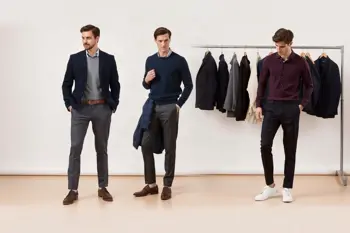
Suit trousers should not automatically be separated from their matching jacket because differences in fading, sheen and wear may become visible over time. When trousers are worn independently, the jacket should contrast clearly in colour or texture rather than appearing almost, but not exactly, like a mismatched suit. Pleats, cuffs and rise are style variables, but none should create pulling at the waist, seat or front crease.
Use knitwear and sneakers for smart-casual occasions
Tailored trousers can move into weekend, travel and evening settings when the upper layer becomes less formal. A high-quality T-shirt, fine knitwear or a casual polo can reduce the business character of wool trousers, especially when the colour palette is tonal or neutral. The top should not be so oversized that it obscures the waistband and destroys the tailored silhouette. 9
Minimalist white leather sneakers create a modern smart-casual contrast, while loafers, clean boots or understated derbies preserve more of the trouser's formal character. Tapered trousers often accommodate these changes most easily, but footwear must follow the hem width: a narrow opening can look unbalanced with a bulky shoe, and a wide leg may require a shoe with enough visual weight to support it.
Layer for seasons and manage maintenance
Layering changes both the visual balance and practical suitability of tailored trousers. A trench coat or wool overcoat can elevate trousers for colder professional environments, while knitwear adds insulation without the bulk of casual outerwear. Seasonal fabric and texture should be considered alongside colour, since lightweight trousers may appear disconnected from heavy winter layers and dense cloth can feel unsuitable in warm conditions.
Maintenance is part of styling because creases, surface wear and poor storage alter the intended silhouette. Trousers should be kept pressed, checked for shine or fading and stored so the crease remains controlled. Alterations may be necessary when the waist, seat or length is incorrect. The main friction point is that tailoring improves appearance but does not remove fabric wear, laundering requirements or the risk of mismatching separately worn suit pieces.
A practical occasion-by-occasion framework
The same tailored trouser can serve several settings when the surrounding garments change in formality. Dark wool is the most formal and office-oriented option; mid-weight neutral trousers can bridge work and dinner; and lighter, textured or cotton-based tailoring is better suited to relaxed environments. Occasion, climate, dress code and expected movement should be assessed together rather than relying on colour alone.
| Occasion | Trousers | Upper layers | Footwear |
|---|---|---|---|
| Office | Navy, charcoal or dark grey wool | Shirt and structured blazer | Leather oxfords or derbies |
| Business casual | Tailored neutral trousers | Knit polo or sweater over a collar | Loafers or refined boots |
| Formal event | Dark formal wool, preferably coordinated | Dress shirt and tailored jacket | Polished oxfords or loafers |
| Weekend | Relaxed tailored or cotton-based trousers | Minimal T-shirt or knitwear | Clean minimalist sneakers |
Sources
- Wessi, “How to Choose the Right Trousers for Every Occasion”
- WhatsNewHub, “How to Style Men's Trousers for Work, Casual Outings, and Formal Events”
- Shop Zavi, “How to Style Tailored Trousers Well”
- The Alex Fashion House, “The Complete Men's Trousers & Chinos Guide”
- Charles Campbell, “Smart Trousers for Men: How to Choose and Style Them”
- CostumePeti, “Formal Trousers Styling Guide”
- D’Marge, guidance on polo shirts and smart sweaters with trousers
- The Trend Spotter, guidance on shoe styles for trouser cuts
- GQ Magazine, guidance on tailored trousers and minimalist sneakers