Vitamin D - dosage and the bone support you can expect: A Clinical Analysis
Vitamin D is widely recognized as a critical nutrient for skeletal health, primarily due to its role in facilitating the body’s absorption of calcium 1. As scientific interest in the compound has grown, so too has the need to distinguish between biological necessity and the perceived benefits of supplementation. Current research indicates that while vitamin D remains a cornerstone of bone metabolism, its effectiveness in preventing fractures and increasing bone mineral density (BMD) varies significantly depending on baseline health status, age, and individual supplementation regimens 2.
The Physiological Role of Vitamin D in Skeletal Health
At the cellular level, vitamin D functions as a secosteroid hormone that regulates calcium homeostasis and bone remodeling 9. The body’s ability to build and maintain strong bones relies on a process where new bone tissue is created and old tissue is resorbed, maintaining a balance known as homeostasis 6. Vitamin D is essential for this cycle, as it enables the gut to absorb calcium effectively, which is then utilized for mineralizing the bone matrix 5, 11.
When an individual experiences a profound lack of vitamin D, the body cannot absorb enough calcium to support healthy bone growth, potentially leading to conditions such as rickets in children or osteomalacia in adults, both characterized by soft or deformed bones 5, 10. Furthermore, beyond the skeleton, vitamin D interacts with receptors in muscles, suggesting a secondary benefit to neuromuscular function and overall physical stability, which can indirectly influence fall risk reduction 5.
Evaluating Dosage Standards and Intake Recommendations
Vitamin D intake is measured in micrograms (μg) or international units (IU), with a standard conversion factor where 1 microgram is equivalent to 40 IU 1. Recommendations for daily intake vary based on age, geographic location, and institutional guidelines. For most healthy adults, the standard advice is approximately 10 micrograms, or 400 IU, per day during months when sunlight exposure is insufficient for natural synthesis 1, 4.
| Age Group | Recommended Daily Intake (IU) |
|---|---|
| Infants 0–6 months | 400 |
| Infants 7–12 months | 400 |
| 1–3 years | 600 |
| 4–8 years | 600 |
| 9–18 years | 600 |
| 19–50 years | 600 |
Clinical caution is advised regarding excessive consumption. Most health authorities suggest that adults should generally not exceed 100 micrograms (4,000 IU) per day from all sources, including fortified foods and supplements, unless explicitly directed by a healthcare professional 4. Exceeding these limits does not result in proportionally stronger bones and carries the risk of toxicity, which may manifest as hypercalcemia or kidney complications 12.
Effectiveness in Fracture Prevention and Bone Density
Recent large-scale meta-analyses and mega-trials have nuanced the long-held belief that vitamin D supplementation is a universal solution for fracture prevention. For community-dwelling, healthy adults, clinical evidence suggests that vitamin D alone may have limited efficacy in reducing the risk of non-vertebral or hip fractures 8, 9. A systematic review of eleven randomized controlled trials involving over 43,000 participants found that while combined calcium and vitamin D supplementation can lead to modest improvements in bone mineral density at the pelvis, it did not significantly reduce overall fracture risk 2.
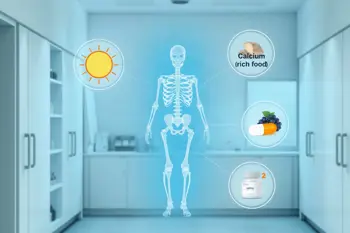
The benefits of supplementation appear most pronounced in individuals with baseline deficiencies or those who are institutionalized and frail 2, 8. In these specific populations, the synergistic effect of vitamin D and calcium acts as a therapeutic intervention rather than a routine prophylactic measure for the general population 8, 9.
Natural Synthesis and Seasonal Considerations
Sunlight exposure remains a primary natural source of vitamin D, as ultraviolet rays react with the skin to initiate synthesis 1. However, this process is highly dependent on geographic latitude and season. In the United Kingdom, for instance, effective synthesis is largely restricted to the period between April and September 1. During this timeframe, short periods of sun exposure-roughly 10 minutes once or twice a day-are often sufficient for the skin to produce required levels 1.
Public health experts emphasize that more is not necessarily better when it comes to sun exposure. Excessive time in the sun without protection increases the risk of skin damage and cancer 1. Because of this, individuals are advised to use sunscreen if they remain in direct sunlight for extended periods and to avoid peak UV hours. Consequently, supplements are often recommended as a safe alternative to manage levels during winter months or for those with limited sun exposure 1, 5.
Holistic Approaches to Skeletal Maintenance
Clinical guidance increasingly emphasizes that vitamin D is one component of a broader skeletal health strategy rather than an isolated remedy. Osteoporosis prevention and the maintenance of bone strength depend on a multifactorial approach that includes adequate dietary calcium intake, weight-bearing and resistance exercises, the cessation of smoking, and the limitation of alcohol consumption 12. These lifestyle factors collectively influence the bone remodeling process, reducing the risk of falls and subsequent fractures 11.
Patients are encouraged to discuss their specific bone health requirements with a healthcare provider, particularly those with underlying conditions like kidney impairment or malabsorptive disorders, which may alter how the body processes vitamin D and calcium 6. Reliance on supplements should be guided by diagnostic testing rather than a one-size-fits-all approach to dosage.
Regulatory Oversight and Clinical Monitoring
The monitoring of vitamin D levels is critical for those on therapeutic supplementation. Serum 25-hydroxyvitamin D (25OHD) levels are the standard clinical marker for evaluating an individual's vitamin D status 2. Regular screening can prevent both the risks associated with persistent deficiency-such as bone weakening-and the risks associated with hypercalcemia, which can result from unchecked supplement use 12.
Healthcare professionals play a vital role in determining when supplementation is necessary, as clinical guidelines for various populations continue to evolve based on emerging research 4. As observed in recent clinical meta-analyses, there is no consistent evidence of a dose-response effect for supplementation duration in healthy postmenopausal women, highlighting the importance of personalized, evidence-based care over routine high-dose supplementation 2.
Sources
- Royal Osteoporosis Society: Vitamin D for bones
- BMC Musculoskeletal Disorders: The effects of combined calcium and vitamin D supplementation
- Endocrinology and Metabolism: Revisiting the Role of Vitamin D in Fracture Prevention
- NHS: Vitamins and minerals - Vitamin D
- European Food Safety Authority: Vitamin D intake guidance
- Hospital for Special Surgery: Calcium Supplements, Vitamin D, and Osteoporosis
- International Osteoporosis Foundation: Essential nutrients for skeletal health
- Cochrane Library: Vitamin D for fracture prevention
- U.S. Preventive Services Task Force: Supplementation for the primary prevention of fractures
- World Health Organization: Micronutrients and bone mineralisation
- Bone Health and Osteoporosis Foundation: Treatment and prevention measures
- Mayo Clinic: Cholecalciferol (oral route) - Side effects and dosage