10-day river cruise from Basel to Amsterdam: Route, itineraries, and practical considerations
A 10-day river cruise from Basel to Amsterdam is typically a Rhine-focused journey through Switzerland, France, Germany, and the Netherlands, combining historic cities, vineyard landscapes, castle-lined valleys, and Dutch waterways. Representative 10-night itineraries include calls at Breisach, Strasbourg, Bernkastel-Kues, Rüdesheim, Cologne, and other river ports before arrival in Amsterdam. 1
Route geography and duration
The route begins at Basel, Switzerland, a city positioned where Swiss, French, and German influences meet. Its Old Town includes narrow medieval streets and Basel Minster, while museums such as the Kunstmuseum and Fondation Beyeler give the embarkation point a strong cultural dimension. From Basel, the river journey commonly proceeds north through Breisach and Strasbourg before entering Germany and continuing toward the Netherlands. 1
Duration requires careful interpretation because operators describe similar journeys differently. AmaWaterways and Avalon Waterways listings identify 10-night cruises from Basel to Amsterdam, while another published Rhine and Moselle itinerary is described as 11 days, including embarkation and disembarkation framing. Shorter eight-day Basel to Amsterdam sailings also exist, so a stated 10-day holiday may represent 10 nights onboard or a broader travel period. 2
Representative itinerary sequence
A published AmaWaterways itinerary starts with embarkation in Basel, followed by Breisach on day two and Strasbourg on day three. Breisach provides access to the Kaiserstuhl vineyards and nearby Alsatian destinations, while Strasbourg offers a border culture shaped by French and German traditions. Later stages of comparable itineraries include Bernkastel-Kues, Cologne, and Amsterdam, although exact port order and time ashore vary by sailing. 1
Another documented northbound itinerary lists Basel, Breisach, Strasbourg, Ludwigshafen, and Rüdesheim among its destinations, with additional stops before Amsterdam. Viking describes its Rhine program through Basel, Breisach, Strasbourg, the Middle Rhine, and Dutch sites such as Kinderdijk. These differences show that “Basel to Amsterdam” identifies the endpoints, not a universal daily schedule. 23
Scenery, heritage, and shore activities
The Middle Rhine is the route’s principal scenic concentration. Viking identifies the region as a UNESCO World Heritage Site lined with castles, cathedrals, and vineyard-covered hills. Other published descriptions emphasize postcard-style towns including Bernkastel and Cochem, as well as the Rhine’s historic cities. The landscape therefore changes from Swiss and Alsatian urban heritage to German wine country, castle scenery, and the lower Rhine approaches to the Netherlands. 34
Excursion formats can be varied rather than limited to city walks. The AmaWaterways description refers to vineyard hikes, cycling beside the rivers, a gondola ride in Rüdesheim, and a hike toward Reichsburg Castle above Cochem. A Christmas-season version adds visits to markets and highlights Trier’s Porta Nigra. The activity level matters because some programs combine coach transfers, walking tours, hikes, and bicycle outings. 4
Ships and onboard arrangements
Several operators serve this corridor, including AmaWaterways, Avalon Waterways, Viking, Uniworld, and CroisiEurope. The documented examples include AmaPrima, Avalon Visionary, and Uniworld’s S.S. Audrey. AmaWaterways describes a fleet of 23 custom-designed five-star river ships, while Uniworld presents a smaller fleet of 13 distinctive luxury vessels. These descriptions reflect operator positioning and should not be treated as a standardized industry rating. 123
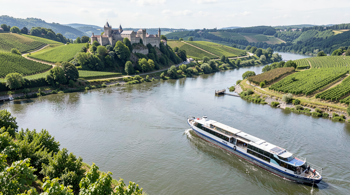
Cabin design differs substantially between ships. Avalon highlights suites with wall-to-wall windows, river-facing beds, and windows that function as open-air balconies. An AmaWaterways holiday description lists spacious staterooms, signature twin balconies on most rooms, onboard fitness classes, included specialty dining, and Wi-Fi. Such features can affect the experience and total fare, but availability, cabin category, and inclusions must be checked for the specific departure. 24
Seasonality and cost context
The principal operating period for Basel to Amsterdam river cruises extends from spring into autumn, with listings showing departures from April through October and additional sailings in other months. Festive itineraries operate in late autumn and winter. A Times Holidays listing documents a 10-night AmaPrima sailing from October 6 to October 16, 2027, while another lists AmaCerto from October 27 to November 6, 2027, with Christmas-market themes. 4
Published fare examples demonstrate a wide range rather than a fixed market rate. The World of Cruising listing gives an AmaPrima 10-night itinerary from £4,777 per person, Avalon’s listing gives £4,319 per person, and Uniworld’s S.S. Audrey example gives £3,799 per person. Global Journeys lists an AmaWaterways 11-day itinerary from A$7,324 per person. These figures are dated examples, not live availability or a direct comparison of equivalent cabins and inclusions. 125
Planning constraints and passenger considerations
The main planning friction is itinerary variation. Some voyages are port-to-port, some count embarkation as day one, and some combine Rhine and Moselle sections. A CroisiEurope listing describes a seven-day Basel to Amsterdam port-to-port cruise, while TourRadar identifies an eight-day Classical Rhine Cruise with 15 destinations. Comparing only endpoint and duration can therefore obscure differences in river coverage, hotel nights, meals, excursions, and transfer arrangements. 67
Passenger suitability also depends on the stated program. TourRadar characterizes one sailing as low intensity, guided in English, suitable for ages eight and above, and organized for groups of 20 to 150 people. Other itineraries may include hikes, cycling, or extended walking in historic centers. The supplied operator descriptions do not establish a single accessibility standard, transport guarantee, or regulatory framework, so mobility needs, transfer details, cancellation terms, and port changes require direct confirmation before travel. 7
What the Amsterdam ending provides
Amsterdam is the northern endpoint of the documented journeys and adds a distinct contrast to the preceding river landscapes. Global Journeys describes the route as moving from Basel’s Swiss setting to Amsterdam’s colorful canals, while Viking’s account emphasizes Dutch engineering at Kinderdijk, where iconic windmills form part of the regional story. The conclusion is therefore associated with canals, water management, and access to the wider Dutch cultural landscape. 23
Arrival planning should distinguish the cruise’s final port from the end of a complete holiday. The research material confirms Amsterdam as the endpoint for multiple itineraries, but it does not specify a uniform disembarkation time, airport transfer, hotel stay, or museum schedule. Travelers assessing a 10-day plan should separate the nights onboard from any pre-cruise Basel accommodation and post-cruise Amsterdam arrangements, then compare the complete schedule rather than relying on the route label alone. 26
Sources
- World of Cruising, AmaWaterways Rhine and Moselle Delights
- World of Cruising, The Rhine and Moselle Northbound
- Viking River Cruises, Rhine Getaway 2026 itinerary
- The Times Holidays, Rhine and Moselle Delights listings
- Global Journeys, Rhine and Moselle Delights
- CroisiEurope, Treasures of the Celebrated Rhine River
- TourRadar, Classical Rhine Cruise