Watercolour course: master the fundamentals step by step: An evidence-based learning framework
What a structured watercolour course should cover
A step-by-step watercolour course normally begins with the relationship between pigment, water, paper, and brush. Watercolour is a transparent medium in which pigment is suspended in water, while the paper often supplies the lightest highlights in an image. This physical characteristic makes preparation important because opaque correction is limited compared with many other painting media. Tate, Britannica, and the National Gallery all describe transparency, water-soluble pigment, and the role of the paper as central features of the medium. 1 2 3
Course descriptions in the supplied research show several distinct teaching formats. The Great Courses lists 14 lessons for a comprehensive beginner class, while David Poxon’s Domestika course contains 21 lessons and nine downloads. A Calgary programme describes eight weekly sessions with demonstrations, exercises, and complete paintings, and Adrian Cooke’s online course is also structured across eight weeks. These examples indicate that “step by step” may mean either a self-paced sequence of lessons or a scheduled progression with repeated practice. 4 5 6 7
Materials, paper, and brush control
Materials instruction is more than a shopping list. A useful foundation explains how brush shape and handling affect marks, how paper weight and surface influence absorption, and how pigment characteristics alter flow, granulation, and edge quality. The research describes courses that introduce materials, brushes, and paper before technical exercises. It also identifies paper preparation and equipment as early subjects in beginner instruction, reflecting the fact that paint behaviour can change substantially when the surface or moisture level changes. 6 8
Brush-control practice should isolate pressure, direction, paint loading, and the amount of water carried in a stroke. Exercises can progress from lines and simple marks to controlled shapes and connected passages. The course material from Watercolor Affair places supplies, brush selection, and paper among its early modules, while Laura McKendry’s course uses exercises such as “Dancing With Your Brushes” and “Taking Your Paintbrush for a Walk.” These structures treat control as a physical skill developed through repetition rather than as a purely theoretical topic. 8 9
Water control and essential washes
Washes form the technical core of beginner watercolour training. Flat washes aim for relatively even coverage, graded washes change in value or intensity, and variegated washes allow related colour shifts within one passage. Wet-on-dry creates clearer boundaries because paint is placed on a dry surface, whereas wet-on-wet allows colour to spread and soften. Winsor & Newton identifies washes, wet-in-wet, wet-on-dry, and lifting among practical watercolour methods, making them suitable milestones for a progressive syllabus. 10
Water timing is particularly important during a wash. Tomo’s learning outline describes the “bead” as a reservoir of wet paint that must be carried continuously to maintain a seamless passage. It also distinguishes the dry and damp phases of paper, noting that adding paint to a drying area can produce blooms or backruns. These observations explain why a course should include controlled tests of moisture, edge drying, and paint movement before students attempt larger compositions. 11
- Flat and graded washes for even or changing coverage. 7
- Wet-on-wet for soft transitions and atmospheric effects. 11
- Wet-on-dry for defined edges and controlled shapes. 10
- Lifting for selectively reducing colour after application. 10
Colour mixing, light, and transparent layering
Colour exercises should connect theory with decisions made during painting. Relevant activities include mixing primary colours, comparing warm and cool versions, neutralising complements, and testing limited palettes. The supplied course data also highlights colour harmonies, colour noise, contrast, focal interest, and the colour of light. These subjects help students consider not only which pigment to use, but also how relationships among colours affect depth, emphasis, atmosphere, and the visual unity of a painting. 12
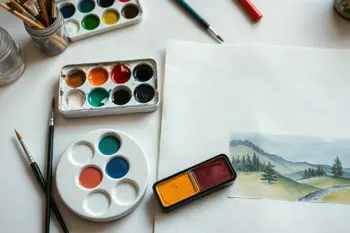
Layering and glazing extend the initial wash without covering the paper’s luminosity. David Poxon’s course specifically includes multicolour layering and multiglazing, while the Calgary curriculum lists layering and glazing alongside colour mixing and water control. A sound sequence allows each layer to dry before another is added, then compares transparent overlaps with mixtures made on the palette. This makes the difference between optical colour interaction and premixed colour easier to observe in practice. 5 6
Planning values, edges, and complete paintings
Planning is essential because dark pigment can be difficult to remove cleanly, and the white of the paper commonly represents the strongest light. Beginner projects therefore benefit from a preliminary sketch, a value plan, and deliberate decisions about which highlights remain unpainted. Gonzalo Ibáñez’s course sequence includes reference selection, a pencil sketch, light and colour plans, construction of light, construction of shadow, and final adjustments. This structure shows how observation and planning can precede technical detail. 12
A practical progression moves from single objects to still lifes, landscapes, florals, and scenes containing atmospheric depth. David Poxon’s final project centres on an ancient stone cottage with shadows, textures, and atmosphere, while other course descriptions include animals from photographs and creative sketchbook illustrations. These projects differ stylistically, but they share a useful principle: students first practise isolated effects, then combine edges, values, textures, and composition in a complete image. 5 9 13
Choosing a learning format and assessing progress
Course formats vary in intensity, feedback, and creative emphasis. The Great Courses presents a beginner-focused 14-lesson structure; Domestika examples range from technical foundations to experimental methods, with Ana Victoria Calderón’s course described as a foundation for later illustration work. A live or recorded eight-week class may provide a regular timetable, while a short daily-learning model divides the subject into 21 bite-sized levels of about five minutes each. The format should be assessed by practice requirements, not lesson count alone. 4 8 11 14
Progress can be evaluated through repeatable tests rather than subjective impressions. Useful evidence includes smoother washes, more consistent edges, cleaner preservation of highlights, controlled wet-on-wet transitions, and colour mixtures that remain harmonious across a painting. Feedback is another practical consideration because watercolour’s damp phase is vulnerable to overworking, and some corrections are best made only after the paper is completely dry. Regional communities can add critique and context: Watercolour New Zealand provides a national watercolour network, while Te Papa offers New Zealand-focused collection and learning resources. 11 15 16
Sources
- Tate, Watercolour: https://www.tate.org.uk/art/art-terms/w/watercolour
- Encyclopaedia Britannica, Watercolor: https://www.britannica.com/art/watercolor
- The National Gallery, Watercolour glossary: https://www.nationalgallery.org.uk/paintings/glossary/watercolour
- The Great Courses Shop, Painting With Watercolors: https://shop.thegreatcourses.com/painting-with-watercolors
- Domestika, The Art of Watercolor: https://www.domestika.org/en/courses/3142-the-art-of-watercolor-paint-your-vision-of-the-world
- In Art Studio, Fundamentals of Watercolour Painting: https://in-art-studio.ca/product/fundamentals-of-watercolour-painting/
- Adrian Cooke Art, First Steps in Watercolour Painting: https://adriancooke.ie/learning/first-steps-in-watercolour-painting/
- Watercolor Affair, Watercolor Masterclass for Beginners: https://www.watercoloraffair.com/course/lets-paint-see-the-3-pillars-in-action/
- Domestika, Creative Watercolor Sketching for Beginners: https://www.domestika.org/en/courses/2373-creative-watercolor-sketching-for-beginners
- Winsor & Newton, Watercolour techniques: https://www.winsornewton.com/row/education/guides/water-colour-techniques
- Tomo, The Art of Watercolour: https://heytomo.app/c/the-art-of-watercolour-419b29
- Domestika, Watercolor Fundamentals: Light and Color: https://www.domestika.org/en/courses/4057-watercolor-fundamentals-light-and-color/course
- Domestika, Experimental Watercolor Techniques for Beginners: https://www.domestika.org/en/courses/482-experimental-watercolor-techniques-for-beginners
- Domestika, Modern Watercolor Techniques: https://www.domestika.org/en/courses/154-modern-watercolor-techniques
- Watercolour New Zealand: https://www.watercolournewzealand.nz/
- Museum of New Zealand Te Papa Tongarewa, Watercolour resources: https://www.tepapa.govt.nz/discover-collections/read-watch-play/maori-art/watercolour