Low-Maintenance Haircuts for a Fresh Everyday Look: A Practical Style Analysis
What Makes a Haircut Low-Maintenance?
A low-maintenance haircut is shaped around the wearer’s natural texture, growth pattern, density, and usual routine rather than a style that depends on daily heat or precise finishing. Wash-and-wear guidance emphasizes that the cut should create useful structure as hair dries, allowing natural movement and even cowlicks to work with the design. The practical objective is reduced styling effort, not the elimination of upkeep altogether. 1
Maintenance also depends on the haircut’s geometry. Blunt bobs and lob-length cuts tend to retain a recognizable outline because their strong perimeter provides structure, while softer layers create movement with less emphasis on exact smoothness. A polished shape may still require regular salon visits, particularly when the outline, fringe, or tapered sections are central to the look. 2
Short Cuts for Quick Daily Styling
Pixies, bixies, and other cropped cuts can shorten washing and drying time substantially. A textured pixie with a soft side sweep keeps extra length through the crown while tapering the sides and nape, creating a shape that can be directed with a small amount of texture cream. The modern bixie preserves some length around the fringe and nape, which gives a softer result while retaining the convenience associated with shorter hair. 1
A flixie offers another short option for fine hair. It combines a grown-out pixie with flicked ends, often at the back and sides, and can be worn tousled or smoothed in selected sections. Short cuts are not maintenance-free, however. Pixies and related shapes generally need more frequent trims than longer styles because growth quickly changes the outline, neckline, and balance of the cut. 4
Bob Variations That Preserve Shape
The blunt bob remains a practical everyday choice when the desired result is a clear, stable silhouette. A jaw-length version can be worn straight, lightly waved, or tucked behind the ears, while a boy bob uses blunt edges, minimal layering, and a deliberately undone finish. Its design differs from the choppier bixie because it relies less on graduated texture and more on a simple perimeter. 6
The Capri bob takes a softer approach, generally sitting from the jaw to the shoulder with subtle layers and gently softened ends. Its intended finish is air-dried, natural, and slightly tousled rather than rigidly polished. A choppy bob also reduces the pressure for perfect smoothing because varied ends create movement and volume. Layering can be adjusted for density, with restrained layering for finer hair and weight removal through the ends for thicker hair. 5 7
Midlength and Shoulder-Length Choices
Shoulder-length and collarbone cuts provide a compromise between short-hair convenience and the styling flexibility of longer hair. The length can usually be worn loose or gathered, and it tends to grow out more evenly than sharply cropped designs. Harper’s BAZAAR describes current midlength shapes as soft, subtly layered, and designed to maintain movement without appearing overworked. 3
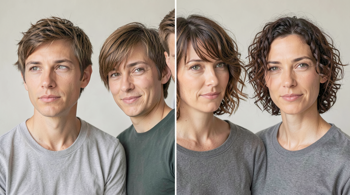
A relaxed shoulder-length bob with curtain bangs adds face framing while retaining enough length for practical styling. Curtain bangs generally transition more softly as they grow than blunt fringe, but they still need periodic shaping to preserve their intended opening and proportions. Long layers are another option for maintaining length while reducing bulk and adding movement, particularly when a one-length shape feels heavy. 1 9
Matching the Cut to Hair Texture
Straight and slightly wavy hair can often support clean one-length cuts, blunt medium shapes, and softly layered designs with limited manipulation. Fine hair may benefit from strategic layering rather than excessive removal, since too many layers can reduce the visual sense of fullness. The flixie and textured pixie use short, irregular sections to create movement, while a blunt perimeter can help preserve density at the edges. 4 7
Wavy, curly, and coily hair require a more individualized cutting plan. Curl pattern, shrinkage, density, and the amount of volume intended at the sides should be considered before choosing a length. A curly pixie can emphasize defined ringlets, while a shag or layered lob can distribute volume and support natural movement. Cutting without accounting for shrinkage can produce a shorter result than expected once the hair dries. 1 10
Everyday Upkeep and Common Trade-Offs
Hair-washing frequency should reflect scalp oiliness, hair texture, scalp condition, and activity level rather than a universal schedule. A low-maintenance cut does not determine how often hair should be washed. The American Academy of Dermatology Association and Cleveland Clinic both describe washing needs as individual, with oilier scalps generally requiring more frequent cleansing than drier or curlier hair types. 11 12
Reducing heat can make a routine simpler and may limit avoidable damage associated with frequent blow-drying, flat ironing, and curling. Air-drying, finger shaping, or using a diffuser can preserve a cut’s intended texture, especially for choppy bobs, shags, and natural waves. The main trade-off is that precise styles still need trims, while sudden or significant shedding is a health concern that should be evaluated by a dermatologist rather than addressed through a haircut alone. 7 13 14
Sources
- ChicnStylish
- Byrdie
- Harper’s BAZAAR
- Short Hair Mag
- Glamour
- ELLE
- Harper’s BAZAAR UK
- Cosmopolitan UK
- Latest Hairstyles
- NaturallyCurly
- American Academy of Dermatology Association
- Cleveland Clinic
- Healthline
- Mayo Clinic