Labrador retriever rescue dogs available for adoption in Canada: A factual guide to listings, suitability, and care
The phrase “Labrador retriever rescue dogs available for adoption in Canada” covers a changing mix of puppies, adult dogs, Labrador mixes, and dogs listed through shelters, breed-specific organizations, and service-dog programs. The records reviewed here show why availability must be verified directly: Gracie’s page states that applications are no longer being accepted, while Matteo’s AARCS profile reports a pending application. 1 2
How adoption status should be interpreted
Rescue profiles are not permanent inventory records. Gracie, a female mixed-breed puppy with a Labrador personality, was described as social with dogs, medium-energy, and still learning house training, but her page explicitly says applications had closed. Matteo, a male Labrador Retriever mix in a Calgary foster home, was described as nine weeks old with an adoption application pending. These examples indicate that a profile can remain visible after interest has already changed its status. 1 2
Other records illustrate different stages of the process. AARCS lists King, a male Labrador Retriever mix born in September 2023, at its Safe Haven, while PADS identifies Donner II as an active, outdoors-oriented dog requiring substantial support with separation stress and emotional regulation. By contrast, PADS pages for Grant, Pandora, and Patty are marked adopted, making them useful behavioral examples but not current adoption prospects. 3 4 7
Examples from Canadian rescue records
The available research shows considerable variation in age, location, and household fit. Finn, an eight-year-old black Labrador Retriever in British Columbia, was reported to be calm, leash-trained, crate-trained, and staying at Bark N’ Fly while under the care of the Okanagan Humane Society. The account said he enjoyed playing with other dogs and receiving attention from staff. 5
| Dog | Record details | Reported considerations |
|---|---|---|
| Gracie | Female mixed breed, 30 pounds and growing | Dog-social, active home, training in progress |
| Matteo | Male Labrador Retriever mix, Calgary foster home | Good with dogs and children; limited cat exposure |
| King | Male Labrador Retriever mix, AARCS Safe Haven | No cats, dog-selective, children aged 12 and older |
| Finn | Eight-year-old black Labrador Retriever, British Columbia | Calm, leash-trained, crate-trained |
Temperament and household suitability
Labrador-type dogs cannot be assessed by breed label alone. Matteo was described as gentle with an older foster dog, comfortable around a cat after limited exposure, and suitable with children. King presents a substantially different management profile: AARCS reports high prey drive, no cats or other small animals, dog selectivity, and a preference for children aged 12 and older. His future household would need structure, secure outdoor space, and continued work on walking manners. 2 3
Donner II demonstrates another form of complexity. PADS describes him as goofy, affectionate, active, and interested in tug toys, outdoor activities, dog sports, and water. The same record says he becomes stressed by transitions and alone time, may bark when startled or left alone, and needs a caretaker working from home plus separation training with a CSAT dog trainer. These requirements can affect housing, schedules, finances, and access to qualified behavioral support. 4
Health, training, and daily maintenance
Rescue adoption involves more than an initial compatibility assessment. Gracie’s record states that she recovered from parvovirus after emergency veterinary treatment and was vaccinated for DACPP, Bordetella, and rabies, microchipped, and spayed. The organization also noted the importance of appropriate parvovirus vaccination for other household pets. Her house training, leash skills, and chewing habits were still developing, showing that puppies require continued supervision and structured learning. 1
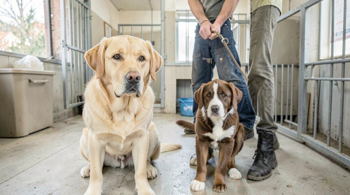
Adult dogs may have different maintenance needs. Finn was described as both leash-trained and crate-trained, while PADS reported that Pandora had right-hip dysplasia without current symptoms. Grant had made progress with resource guarding but required continued support, and Patty was sensitive to harnesses, tight spaces, and unfamiliar surfaces. Such records demonstrate that behavioral progress and medical information should be treated as ongoing management considerations rather than permanent guarantees. 5 7
Where Canadian adopters typically find records
Canadian rescue information is distributed across national databases, provincial agencies, municipal humane societies, and breed-focused groups. Petfinder is identified as a searchable hub for Canadian shelters and rescues listing Labrador Retrievers and mixes. The BC SPCA, Montreal SPCA, Edmonton Humane Society, Ottawa Humane Society, Winnipeg Humane Society, and Nova Scotia SPCA are also identified as organizations that maintain adoption or animal-welfare services relevant to Labrador-type dogs. 8 9 11
Breed-specific coverage also exists. Labrador Retriever Adoption Service Inc. specializes in rescuing and rehoming Labradors throughout Ontario, while Adopt-a-Pet is identified as a platform connecting Canadian adopters with regional rescue organizations. Listings may reflect animals in foster homes, shelter facilities, or transfer programs, and location can affect interviews, transportation, meet-and-greets, and post-adoption support. 10 12
Application procedures and adoption risks
Canadian rescue organizations commonly use formal applications, reference checks, and home visits before finalizing an adoption. These steps are eligibility and safety measures, not automatic approvals. Organizations may evaluate household composition, landlord permission, yard security, work schedules, existing pets, experience with training, and the ability to manage medical or behavioral needs. The research also identifies typical adoption fees of approximately $300 to $700 CAD, generally associated with spay or neuter surgery, vaccinations, and microchipping. 13
Potential friction points include incomplete history, changing status, transportation between provinces, and differences between shelter behavior and home behavior. Rescue groups may provide health screening and behavioral assessment, but those assessments cannot eliminate uncertainty. High energy, prey drive, separation anxiety, resource guarding, or sensitivity to handling can continue after placement. Responsible evaluation therefore includes planning for veterinary care, training, enrichment, secure containment, exercise, and the possibility that household routines will need to change. 13
Practical evaluation before adopting
A careful review should compare the dog’s documented needs with the household’s actual capacity. Questions should address alone-time tolerance, compatibility with children and animals, training progress, medical history, transport arrangements, and whether the organization requires a fenced yard or particular age restrictions. For dogs such as King or Donner II, the behavioral restrictions are central to suitability, not minor qualifications. For puppies such as Gracie or Matteo, house training, chewing, socialization, and supervision are central maintenance realities. 1 2 3 4
The records also support checking status and requirements immediately before making plans. A page may say applications are closed, pending, or adopted, and a news report may direct readers to an organization’s own website for updated information. The most reliable interpretation is therefore a documented snapshot, followed by direct confirmation of current status, location, eligibility rules, and support requirements through the responsible rescue or shelter. 1 5 7
Sources
- HART, “Gracie 2026-008”
- AARCS, “Matteo”
- AARCS, “King”
- PADS, “Donner II”
- West K News, “Okanagan Humane Society: Finn’s quest for his forever home”
- Revelstoke Review, “Okanagan Humane Society: Finn’s quest for his forever home”
- PADS, “Grant,” “Pandora,” and “Patty” records
- Petfinder
- BC SPCA
- Labrador Retriever Adoption Service Inc.
- Montreal SPCA, Edmonton Humane Society, Ottawa Humane Society, Winnipeg Humane Society, and Nova Scotia SPCA
- Adopt-a-Pet
- General Canadian rescue adoption process research