Romantic Italian vacation: 7-day trip with hotel and flights in 2026: An itinerary and planning review
A romantic Italian vacation: 7-day trip with hotel and flights in 2026 typically requires balancing arrival logistics, six hotel nights, sightseeing reservations, and travel between major cities. A practical structure uses four nights in Rome followed by two nights in Florence, although northern routes through Venice, Verona, and Lake Garda also provide a documented seven-day alternative. 1
How to structure seven days
The Rome and Florence format creates a six-night trip rather than seven hotel nights. Four nights in Rome allow time for the Colosseum, Vatican Museums, historic piazzas, and a slower evening schedule, while two nights in Florence provide access to Renaissance sights, the Arno River, and Tuscan experiences. The return flight may depart from Florence or Rome, depending on the confirmed 2026 flight schedule and fare structure. 2
A northern Italy alternative follows Venice, Lake Garda, and Verona. One documented route allocates three nights to Venice, two to Lake Garda, and two to Verona, using trains, ferries, and taxis rather than a car. Another seven-day tour combines Venice, Verona, Milan, Lake Como, and Lugano, with three nights in Venice and a centrally located four-star hotel with breakfast. 3
Rome and Florence itinerary outline
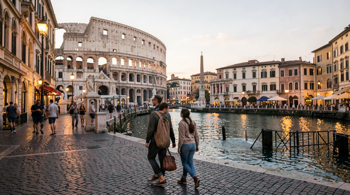
Days one through four can be based in Rome. Arrival day is suited to hotel check-in and a walk through the historic center, while later days can be divided between the Colosseum archaeological area and Vatican City. A longer stay also permits quieter time around fountains, gardens, and riverfront areas instead of treating every visit as a rapid checklist. The Colosseum, Roman Forum, and Palatine Hill are administered through the official archaeological park. 4
Days five and six can move to Florence by high-speed rail, followed by a return flight on day seven. Florence-focused planning may include an Arno River visit, a guided bicycle outing, Renaissance art, a thermal spa, and a Tuscan excursion. A documented seven-day couples itinerary specifically includes a private Arno tour, bicycle exploration, and spa time, showing how the city can support both cultural sightseeing and slower activities. 5
Hotels and what the package wording means
“Hotel and flights” describes a travel combination, not a universally standardized package. The accommodation portion may involve one Rome hotel and one Florence hotel, or a single-city base with rail excursions. Hotel Artemide is identified in the research as a central Rome option with direct reservation facilities, but its 2026 room rates, availability, cancellation terms, taxes, and included services require confirmation through the property’s current information. 6
Hotel selection should be assessed by location, room category, breakfast conditions, transfer arrangements, accessibility, and cancellation rules. A centrally located property can reduce local transport time, but central areas may also have pedestrian restrictions, evening noise, or higher rates. Package descriptions elsewhere in the research specify four-star accommodation and breakfast for parts of a northern Italy itinerary, while other tours list luxury villas or five-star properties, demonstrating substantial variation in lodging standards. 7
Flights and intercity transport
Direct London to Rome services are associated with carriers including British Airways and ITA Airways, but flight schedules and 2026 availability must be checked against the intended departure airport, baggage conditions, connection requirements, and return-city plan. An open-jaw arrangement, arriving in Rome and departing from Florence, may reduce backtracking, although the practical value depends on the selected flights and rail connections. 8
Rome and Florence are linked by high-speed rail services operated by Trenitalia and Italo. Official rail platforms provide schedules, fares, and booking information, and the journey should be coordinated with airport arrival times and hotel check-in policies. Northern itineraries use a different transport pattern, including Venice water buses, ferries around Lake Garda, and trains between destinations, so a route that looks geographically compact can still require several separate transfers. 9 10
Entry requirements and 2026 planning
British passport holders can generally enter Italy without a visa for stays of up to 90 days in any 180-day period, provided the passport satisfies Schengen validity requirements. Entry rules can differ by nationality, purpose, and travel document, so the applicable government guidance should be checked before a booking is treated as final. Passport validity, border questioning, travel insurance, and evidence of onward travel can create practical friction even when a visa is not required. 11
The European Union expects ETIAS travel authorisation to begin in the final quarter of 2026. That timing means travellers whose dates fall late in the year should verify whether the system applies to their nationality and itinerary. Italian visa information is also published by the country’s Ministry of Foreign Affairs. Regulatory requirements are separate from airline or hotel terms, and changes to either category can affect the trip’s documentation needs. 12 13
Reservations, timing, and travel risks
Short trips leave little room for missed reservations. The Colosseum and Vatican Museums are major Rome attractions with official visitor and ticketing information, so entry arrangements should be checked before assigning fixed sightseeing times. Venice may also apply a visitor access contribution on applicable dates, according to the city’s official portal. The charge is date-sensitive, and its applicability should not be assumed for every visit or every traveller. 14 15
Late spring and early autumn are generally associated with more comfortable sightseeing conditions than Italy’s hottest summer months, but exact 2026 weather cannot be guaranteed. Rain, heat, transport disruption, crowded attractions, and luggage movement between hotels remain relevant risks. A resilient plan keeps one flexible period, confirms cancellation and refund rules, avoids scheduling major attractions immediately after a long flight, and preserves realistic time for station, airport, and hotel transfers.
Comparison of the main seven-day formats
| Route | Hotel pattern | Distinctive elements | Main planning issue |
|---|---|---|---|
| Rome and Florence | Four nights in Rome, two in Florence | Ancient Rome, Vatican City, Renaissance Florence, rail transfer | Coordinating an international return flight with the final rail journey |
| Venice, Lake Garda, and Verona | Three nights in Venice, two at Lake Garda, two in Verona | Gondola travel, lagoon islands, lakeside walks, Romeo and Juliet associations | Multiple ferries, trains, taxis, and hotel changes |
| Venice, Verona, Milan, Lake Como, and Lugano | Four-star central hotel and regional stays | Canals, fashion and culture, lakes, and Switzerland | A dense route with limited unstructured time |
The choice depends on whether the priority is concentrated art and history or a broader northern landscape route. Venice-focused research includes gondola rides, Murano glassmaking, Burano’s colourful streets, Verona’s Roman Arena, and Lake Garda boat travel. Florence research emphasizes Renaissance culture, cycling, thermal relaxation, and Tuscan scenery. Neither structure guarantees a particular room, flight, or attraction entry, because those details remain dependent on date-specific confirmation. 1 2
Sources
- JAINVOYAGERS EUROPE
- Build a Break
- Letty World Travel
- Parco archeologico del Colosseo
- Zicasso, Capital of Romance: Essential Couples’ Tour to Florence, Tuscany
- Hotel Artemide
- Northern Italy and Switzerland Tour
- British Airways and ITA Airways
- Trenitalia
- Italo
- GOV.UK Foreign Travel Advice for Italy
- European Union ETIAS
- Italian Ministry of Foreign Affairs
- Comune di Venezia
- Vatican Museums and Met Office