Modern Options for Replacing Missing Teeth in 2026: An Analytical Review of Restorative Clinical Advancements and Patient Considerations
For individuals affected by tooth loss, 2026 represents an advanced era in restorative dental medicine, offering replacement options that are more comfortable and durable than ever 2. Modern clinical developments have transformed how dentists approach tooth loss, moving toward permanent, biomechanically stable solutions 12. From high-tech implants to digitized dentures and specialized implant bridges, understanding these contemporary restorative options is essential for restoring oral function and long-term structural health 1, 2.
The Evolution of Modern Restorative Dentistry
The landscape of restorative dentistry in 2026 is defined by extreme precision and rapid digital workflow integration. As care shifts toward permanent, life-improving outcomes, the demand for sophisticated missing tooth replacement has risen. Statistics show the United States implant market is valued at approximately $1.5 to $1.6 billion, with adoption rates between 17% and 23% among adults suffering from tooth loss 7. Replacing a missing tooth is critical for maintaining overall jaw structure 2.
Modern clinical environments have integrated computer-aided design and manufacturing (CAD/CAM) 17. Three-dimensional (3D) imaging and digital simulations allow clinicians to plan exact placements of restorations 12. Peer-reviewed research confirms that 3D-printed devices offer fit accuracy and strength comparable to traditional milling, reducing patient chair time 17.
Dental Implants as the Anchor-Based Standard
Dental implants remain the clinical gold standard for long-term tooth replacement in 2026 2. Unlike older, tooth-supported designs, an implant is a three-part system consisting of a post, an abutment, and a custom crown 7. The biocompatible post is surgically integrated into the jawbone, initiating osseointegration 3. This biological bonding process typically completes within three to six months, creating a stable anchoring platform 3.
Material innovations have expanded clinical choices. Traditional titanium implants, typically 5 millimeters in diameter, are highly durable but require sufficient bone density 14. For patients seeking metal-free alternatives, zirconia ceramic implants offer excellent biocompatibility 23. Modern screwless implants utilize precise locking-taper connections to join components, minimizing screw-loosening complications and creating a hygienic seal 27.
The Mechanics and Application of Modern Implant Bridges
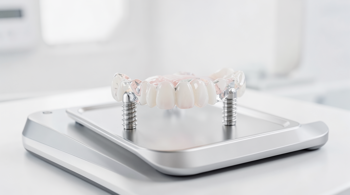
When replacing multiple adjacent teeth, patients historically relied on removable partial dentures or conventional tooth-supported dental bridges 26. Conventional bridges require adjacent healthy teeth to be permanently ground down to act as anchors, risking long-term decay of healthy enamel 26, 30. The modern implant bridge bypasses natural teeth entirely by placing titanium or zirconia posts at each end of the gap, securing a custom-milled, continuous prosthetic bridge 30.
Implant-supported bridges actively stimulate the underlying jawbone through force distribution, preventing progressive bone resorption 30. This preservation of bone volume prevents the collapsed facial appearance commonly observed with traditional denture use 11, 30. Patients using modern implant bridges report chewing with up to 90% of their natural biting force, far exceeding removable alternatives 29.
Full-Arch Restorations: Comparing All-on-X Systems
For individuals facing total tooth loss, full-arch reconstruction offers fixed, non-removable solutions that replace an entire upper or lower jaw 6. Rather than placing an individual implant for each missing tooth, these systems position a limited number of posts to carry a complete prosthetic arch 18. The choice between these configurations depends heavily on the patient's remaining bone density, anatomical structure, and biting force 6.
| Restoration Type | Implants Per Jaw | Common Materials | Bone Volume Requirement | Primary Clinical Advantages |
|---|---|---|---|---|
| All-on-4 | 4 posts (2 tilted, 2 straight) 6, 25 | Zirconia or acrylic hybrid 6 | Low to moderate 6 | Minimizes need for bone grafting 6 |
| All-on-6 | 6 posts 6 | Zirconia or titanium hybrid 6 | Moderate to high 6 | Provides maximum load distribution 6 |
| Toronto Bridge | 4 to 6 posts 6 | Acrylic teeth on titanium frame 6 | Low to moderate 6 | Acrylic teeth absorb chewing shock 6 |
Clinical success rates for fixed full-arch concepts consistently exceed 95% at ten years 18, 20. The implementation of tilted implants in systems like All-on-4 allows clinicians to leverage dense bone structures, allowing patients with limited bone density to receive stable, fixed restorations without undergoing complex bone grafting surgeries 6, 28.
The Transformation of Modern Removable Dentures
The Transformation of Modern Removable Dentures
Removable dentures have undergone significant technical advances, shaking off traditional stigmas associated with older, bulky plastic designs 11, 17. Modern CAD/CAM design and 3D printing enable the fabrication of dentures with thinner, highly accurate gum-colored bases 17. Digital shade matching and individualized tooth shaping allow dentists to match natural tooth color tones and slight structural irregularities, rendering modern dentures highly realistic 17.
For patients seeking stability without the cost of a fixed bridge, snap-in implant dentures represent a functional middle-ground 22. These removable overdentures utilize two to four mini dental implants, which are narrow titanium screws measuring less than 3 millimeters in diameter 24. Mini implants are less invasive to place than conventional implants and successfully anchor a denture in patients with limited bone volume, eliminating shifting 14, 24.
Clinical Candidacy, Structural Risks, and Maintenance Realities
Despite high success rates of modern tooth replacement options, frequently exceeding 95% over ten years, it is critical to understand clinical risks, eligibility criteria, and maintenance realities 3, 20. Dental implants require adequate bone density and healthy gums to achieve osseointegration 10. Patients lacking sufficient jawbone volume must undergo preliminary preparatory procedures such as bone grafting, adding substantial healing time 14.
Furthermore, financial and long-term maintenance profiles vary significantly. Traditional dentures have a lower upfront cost but require periodic professional relines and do not halt natural bone loss 8, 22. Fixed implants are highly cost-effective over a decade due to exceptional durability 29. However, even permanent implants are susceptible to peri-implantitis, an inflammatory condition caused by poor hygiene, meaning strict daily brushing and flossing are mandatory to prevent long-term failure 1, 29.
Sources
- Amore Dental Arts
- Brisbane Smiles
- Dental Country
- Allstars Dental Guide
- Star Dental Care
- Stom Dental Centre
- Good Tooth Dental Care
- Capital Region Periodontics
- Meadowvale Town Dentist
- Latrobe Family Dental
- Genesis Dentists
- Nuvo Dental Florida
- Golden Square Dental
- Carter-Rockbridge General Dentistry
- DentPrime Clinical Guide
- Kallangur Dental Surgery
- Genesis Dentists Modern Options
- NV Implant Center
- Allstars Dental Quality Guide
- Lemont Dental Clinic
- Beauty and the Mist
- Fusion Dental Implants
- Kristal Clinic
- East Longmeadow Family Dental Center
- Ebrahimian Integrative Dentistry
- Westbrook Dental
- Pearl Dental Group
- Ridgetop Dental Implants
- Annandale Smiles
- My Gentle Dentist Arana Hills