PVC wall panels for UK homes: durability, maintenance, and style choices: An evidence-based review
PVC wall panels for UK homes are increasingly considered as an alternative to tiles in bathrooms, shower rooms, kitchens and utility areas. Their appeal rests on waterproof surfaces, fewer joints and simpler cleaning, but long-term performance depends on panel construction, installation quality, ventilation and correct use around heat sources. 1
Moisture performance in UK homes
PVC panels are made from polyvinyl chloride and are intended for humid interior environments. Their largely non-porous surfaces do not absorb water in the same way as porous wall finishes, while sealed panels can protect the underlying wall from splashes and condensation. This makes them particularly relevant to bathrooms, en-suites, cloakrooms and shower areas, where repeated water contact can contribute to staining, mould and surface deterioration. 1
UK homes may also experience winter condensation, changing indoor temperatures and limited airflow, particularly in older properties. These conditions can affect wall finishes in bathrooms, kitchens, utility rooms and entrance halls. PVC is resistant to swelling, warping and rot when the product is designed for wet areas, although the wall behind the panel can still be damaged if joints, corners or penetrations are inadequately sealed. 413
What determines durability
Durability is not determined by the word PVC alone. Panel thickness, rigidity, surface finish, core construction, fixing method and substrate preparation all influence service performance. The supplied installation guidance describes common interior panels as approximately 8 to 10 millimetres thick, although dimensions vary by manufacturer. Lightweight hollow or cellular sheets can be easier to handle, but some products may be more vulnerable to dents, cracking or impact than more rigid constructions. 59
Surface finish also affects how wear appears. Gloss surfaces reflect light and can make small rooms appear brighter, but smudges, water marks and limescale may be more noticeable. Matt surfaces reduce reflection and can create a softer appearance, while ultra-matt products are described by one manufacturer as having enhanced scratch resistance. These are product-specific characteristics rather than universal properties, so technical specifications and warranty terms should be checked before selection. 28
Installation and hidden water risks
Many PVC bathroom panels can be installed over existing tiles or another sound, prepared surface. This can reduce demolition, dust and disruption compared with removing tiles before applying a new finish. Tongue-and-groove systems are common, and panels are typically cut with standard woodworking tools. However, over-tiling does not remove the need to assess whether the existing wall is stable, dry, level and capable of supporting the chosen adhesive or fixing system. 57
Water resistance depends on the complete installation rather than the sheet material in isolation. Manufacturers’ specified trims, compatible sealants, corner details and sealed service penetrations are important at shower edges, wall junctions and around fittings. Poorly sealed joints can allow water behind the panels, creating damp or substrate damage that may remain hidden. Shower-area systems should therefore be installed exactly according to their technical instructions, and panels should not be treated as an automatic substitute for every form of waterproofing. 113
Maintenance and cleaning realities
The main maintenance difference from tiled walls is the absence of cement grout across the panel surface. A non-porous, grout-free finish can reduce the areas where soap residue and mould commonly accumulate, and routine cleaning generally involves wiping rather than scrubbing joints. After showering, a soft microfibre cloth or squeegee can remove droplets and reduce limescale caused by standing mineral-containing water. 3
A weekly cleaning routine described in the research uses warm water, a small amount of washing-up liquid and a soft cloth, followed by rinsing and drying. White vinegar diluted with warm water is suggested for limescale, while bicarbonate of soda mixed with water may address soap scum. Abrasive pads and harsh acidic limescale products can dull some gloss finishes. Silicone joints remain a maintenance point because mould may develop there before it appears on the panel itself. 3
Style choices and room perception
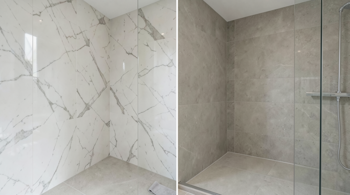
Current PVC panel designs extend beyond plain white surfaces. Available appearances include marble, stone, concrete, wood grain, decorative patterns, tile effects, plain colours, gloss and matt textures. These formats allow a bathroom to imitate traditional tiled layouts or adopt a continuous contemporary wall. Marble and stone effects can provide visual pattern without grout lines, while wood effects may introduce a warmer appearance, although the suitability of a particular design depends on the surrounding fittings, lighting and room proportions. 710
Gloss and matt finishes create different visual conditions even when the underlying panel construction is similar. Reflective gloss can distribute natural and artificial light in a small or north-facing bathroom, potentially making it feel more open. Matt surfaces soften reflections and may better suit restrained or traditional interiors. Finish choice also has a practical dimension because reflections, fingerprints, scratches and water deposits can be more or less visible depending on colour, pattern and sheen. 28
Safety, environmental factors and selection checks
Fire performance requires product-specific verification, especially near kitchens, heaters and escape routes. The supplied UK guidance distinguishes BS 476-7 surface-spread-of-flame classifications from the European EN 13501-1 reaction-to-fire system. It reports that some 8 and 10 millimetre panels are Class 1 to BS 476-7, while 5 millimetre panels are typically Class 3, but these statements cannot be applied to every manufacturer or installation. Relevant requirements should be checked against Approved Document B and the product’s certification. 611
PVC is recyclable in principle, although recovery can be complicated by adhesives, bonded laminates, trims and mixed-material construction. A considered specification should therefore examine the panel’s wet-area suitability, thickness, coverage, dimensions, warranty, required adhesive, trims, cleaning instructions and future availability of matching accessories or replacement sheets. This approach addresses both immediate appearance and the practical risks of repair, maintenance and end-of-life handling. 1213
| Check | Why it matters |
|---|---|
| Thickness and core | Influence rigidity and resistance to impact. |
| Joint and trim system | Helps control water entry at edges and corners. |
| Fire documentation | Clarifies suitability near heat sources or regulated locations. |
| Cleaning instructions | Reduces the risk of surface dulling or damage. |
Sources
- Walls and Floors, “PVC Wall Panels for Bathrooms: Benefits, Designs & Installation Guide”
- PanelDeals, “Matte vs Gloss PVC Wall Panels: Which Wins?”
- PanelDeals, “How to Clean PVC Wall Panels: UK Care Guide”
- Britwall, “PVC vs MDF Wall Panels: What Works Best in the UK Climate?”
- Crecso, “How to Install PVC Wall Panels: A Complete UK Guide”
- PanelDeals, “Are PVC Wall Panels Fire-Rated? UK Building Regs”
- Plumbing World, “20 PVC Kitchen & Bathroom Wall Panel Ideas”
- Easy Panels, “Choosing the Right PVC Panel Finish”
- Pro-Tek, “PVC Wall Panels vs. SPC: The Ultimate Buyer’s Guide”
- Easy Panels, “PVC vs Acrylic vs Laminate Panels”
- GOV.UK, Approved Document B
- British Plastics Federation, PVC Recycling
- NHBC Foundation, moisture control guidance