LED light therapy price list: A 2026 market cost analysis
This LED light therapy price list provides a neutral overview of 2026 pricing across home devices, professional sessions, facial treatments, memberships, and commercial equipment. Reported costs vary substantially according to treatment area, device output, wavelengths, location, and whether treatment is delivered at home or under clinical supervision. 1
Professional session pricing
Individual professional LED or red light therapy sessions generally occupy a broad range. A market pricing guide reports $40 to $150 for a 20 to 30 minute in-clinic session, while broader studio research places single sessions between $25 and $200 depending on whether the appointment is targeted or full-body. 2 A published San Diego menu lists 15-minute sessions at $49 and 30-minute sessions at $65, illustrating how session length and local operating costs affect the final figure. 6
| Service type | Reported range | Reference context |
|---|---|---|
| Targeted or handheld session | $25 to $200 | Studio variation by treatment format |
| In-clinic session | $40 to $150 | Usually 20 to 30 minutes |
| San Diego example | $49 to $65 | 15- or 30-minute appointments |
Packages, memberships, and facial add-ons
Recurring treatment structures can change the effective cost per visit, but they also require a continuing treatment schedule. Dedicated studios report monthly memberships from $59 to $249 for unlimited access, while boutique skincare memberships are commonly described in the $100 to $200 range. 1 A San Diego provider lists four 15-minute sessions at $135 and four 30-minute sessions at $189. 6 These figures are provider examples rather than universal rates.
- Clinic packages commonly cover four to twelve sessions and range from $250 to $1,200. 2
- Six-session professional packages are often reported between $150 and $450. 11
- LED added to a facial commonly increases the appointment price by $30 to $50. 12
- New York City stand-alone LED sessions are reported at $85 to $185, while LED-plus-facial appointments range from $145 to $385. 3
Home device price ranges
Home equipment spans the widest consumer range because products differ in coverage, construction, irradiance, wavelength selection, warranty terms, and controls. Research places home-use devices from approximately $100 to more than $11,000, although most consumers purchasing mid-range panels spend about $300 to $1,700. 1 Another market table places home panels at $150 to $800, while a panel-specific review reports approximately $99 to $1,299 for many devices and identifies premium full-body panels above $1,699. 4
| Home category | Typical reported range | Primary coverage |
|---|---|---|
| Handheld device | $50 to $300 | Small targeted areas |
| LED face mask | $99 to more than $1,900 | Face and skin |
| Wearable pad | $150 to $700 | Joints, muscles, or localized areas |
| Medium panel | $300 to $1,500 | Torso or broader home treatment |
| Full-body home panel | $400 to $2,500 | Large surface areas |
Commercial and professional equipment
Commercial systems have a different cost structure from consumer devices because they are designed for repeated use, larger coverage, and professional environments. Published category estimates place large panels at $1,200 to $3,500 and full-body systems at $3,000 to more than $7,000. 5 A commercial equipment guide lists seven 2026 tiers from a $9,995 portable pad and a $10,571 modular clinical set to beds priced between $29,997 and $95,995. 10 Installation, financing, room preparation, and service arrangements can add to the equipment cost.
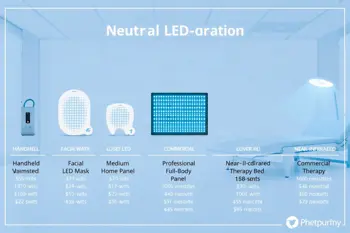
- Professional systems generally cover more of the body than handheld or facial products.
- Commercial pricing reflects diode count, frame size, output, controls, durability, and clinical workflow requirements.
- Equipment intended for clinics may require staff training, documented operating procedures, and appropriate electrical setup.
- Published equipment prices should not be confused with the per-session price charged to a client.
What determines the quoted price
Surface area is one of the clearest pricing variables. A spot-treatment device uses fewer LEDs and a smaller housing than a torso panel or full-body bed. Wavelength configuration also matters: products may combine red, blue, green, or near-infrared light, with some systems offering two wavelengths and others offering eight. 5 Irradiance, or power density, influences treatment distance and session design, while higher-output hardware generally raises the purchase price. 13
| Cost driver | How it affects pricing |
|---|---|
| Coverage area | More LEDs and larger frames increase hardware requirements. |
| Wavelengths | Additional light bands and controls add technical complexity. |
| Irradiance | Higher output can require stronger power supplies and thermal management. |
| Certification and warranty | Testing, documentation, and longer support periods may increase the listed price. |
| Location and labor | Clinical staffing, rent, setup, and appointment time affect service fees. |
Regulation, eligibility, and ongoing costs
Price comparisons should distinguish wellness products from devices used in regulated medical or aesthetic settings. Medical-grade panels may be FDA-cleared for specific uses, but clearance does not mean that every claimed benefit applies to every condition. 11 Some providers state that HSA or FSA funds may cover devices or sessions when a qualified clinician prescribes treatment for a diagnosed medical condition and the required documentation is available. 1 Eligibility depends on the plan, diagnosis, prescription, and documentation, not simply on the device label.
Additional costs can include replacement leads, wristbands, goggles, stands, mounting hardware, setup, and maintenance. A cost guide places accessories and replacement parts at $20 to $150 and warranty or maintenance expenses at $0 to $120, depending on the provider and plan. 2 Photodynamic LED treatment at one London clinic starts from £50 for a 30-minute appointment, demonstrating that currency, geography, and clinical positioning materially affect comparisons. 7 Users should also consider eye protection, contraindications, medication interactions, and the possibility that symptoms may require conventional medical assessment rather than light therapy alone. 8
Sources
- Red Light Finder, redlighttherapyfind.com
- LatestCost, latestcost.com
- The New York Facial, thenewyorkfacial.com
- Lifespan Vault, lifespanvault.com
- RainbowDO, rainbowdo.com
- Light Therapy San Diego, lighttherapysandiego.com
- Bodyvie, bodyvie.com
- Mediglow, mediglow.ie
- Sync Therapy, synctherapy.ca
- RecovAthlete, recovathlete.com
- Healthline
- Vogue
- Cleveland Clinic